
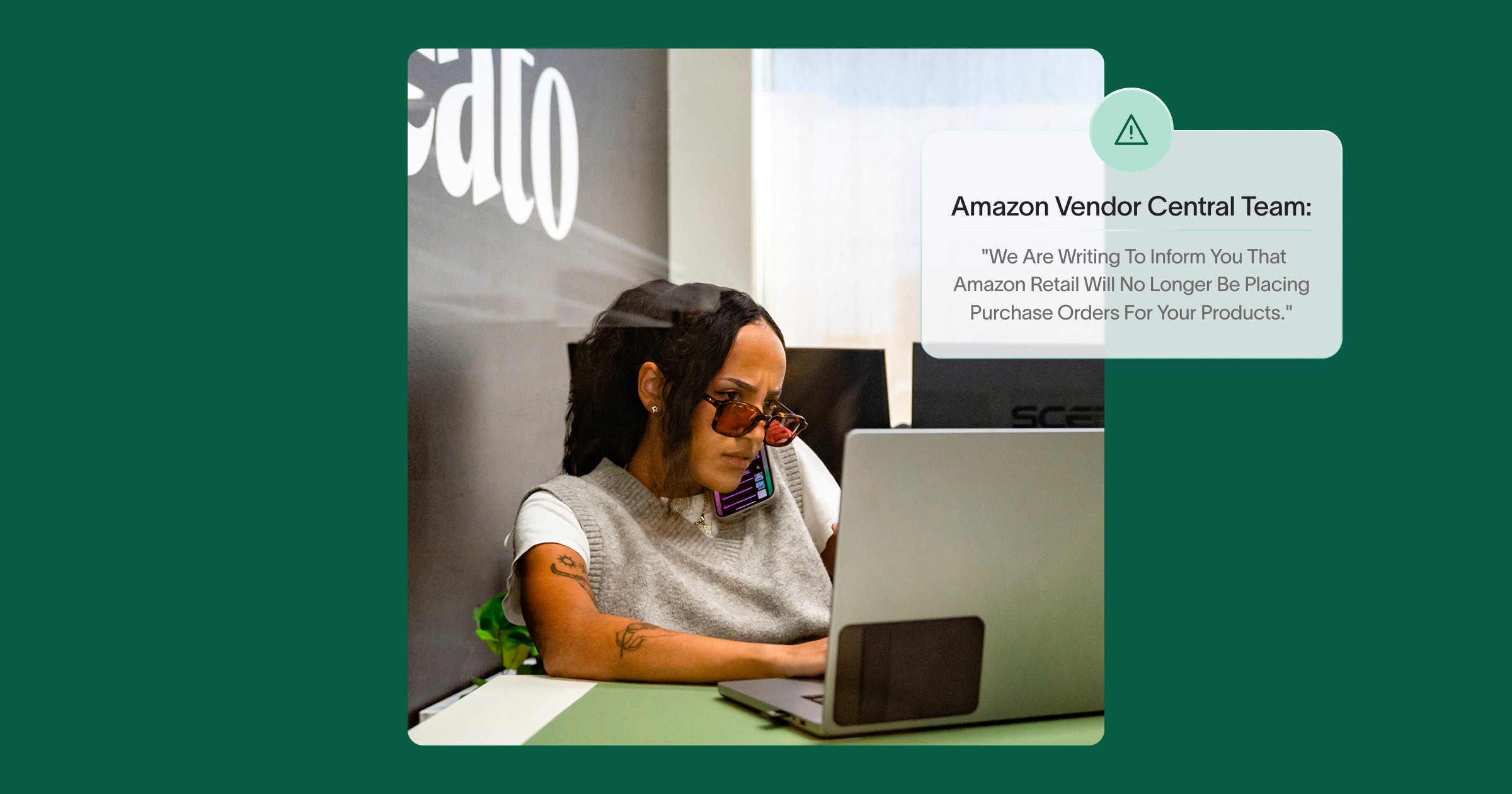
The email arrived on a Tuesday at 4:47 PM. “We are writing to inform you that Amazon Retail will no longer be placing purchase orders for your products.” A VP of Sales at a mid-market snack brand — a Neato partner — forwarded it to our team within minutes. Nine years as a 1P vendor. No warning. No negotiation. A form letter and a 60-day countdown.
She’s not alone. Amazon vendor central termination has accelerated dramatically since 2023, and the pace in 2025–2026 has only intensified. Marketplace Pulse data shows Amazon steadily reducing its 1P vendor base, concentrating retail purchasing on the highest-volume, highest-margin SKUs while pushing everyone else toward Seller Central. The pattern is clear: if your brand does less than $10M annually through Vendor Central, you’re in the crosshairs. Even some brands well above that threshold have gotten the letter.
This guide breaks down what’s happening, why, and how to execute a 1P to 3P transition without cratering your revenue.
Why Amazon Is Terminating 1P Vendors
Amazon’s 1P model was built for a different era — when Amazon needed brands more than brands needed Amazon. Vendor Central was the invitation-only club. Amazon bought your inventory at wholesale, handled fulfillment, owned the listing, set the price. Brands loved the simplicity. Amazon loved the selection.
The economics stopped working.
Margin compression. Amazon’s retail margins on CPG products run 3–5% after freight, storage, and chargebacks. Every cost increase eats directly into Amazon’s P&L. On a 3P transaction, Amazon collects ~15% referral fee plus FBA fees with nearly zero inventory risk.
Operational complexity. Managing purchase orders, vendor negotiations, and co-op programs for tens of thousands of vendors requires enormous overhead. Amazon can service seller accounts at a fraction of the cost.
Control recapture. When Amazon is the 1P seller of record, it absorbs the cost of price wars, CRaP-outs (Can’t Realize a Profit), and margin erosion. Pushing brands to 3P shifts that burden.
Industry estimates from Profitero suggest the active 1P vendor base has contracted by 30–40% since 2021 [VERIFY]. The brands that remain tend to be mega-CPGs: Procter & Gamble, Unilever, Nestlé — companies with enough volume to justify Amazon’s retail investment.
The Termination Timeline
Day 0: The notification. Amazon sends an email stating they’ll no longer place purchase orders. You’re being offboarded.
Days 1–14: The scramble. Calls to Amazon vendor managers go unanswered (or the VM has been reassigned). Legal reviews the terms. Leadership convenes.
Days 15–45: The transition window. This is where execution matters. Stand up a Seller Central account, migrate ASINs, transfer brand registry, set up FBA, and ensure you don’t lose Buy Box ownership during the transition.
Days 46–60: The cutoff. Amazon stops placing POs. Existing warehouse inventory may continue selling, but once it’s gone, it’s gone. If your 3P operation isn’t live, your listings go dark.
Post-cutoff: The long tail. MAP violations from unauthorized sellers. Orphaned listings. Price instability. Most brands lose 20–40% of their Amazon revenue here — not from the termination itself, but from the messy aftermath.
What a 1P to 3P Transition Actually Involves
1. Account Architecture
You need a Professional Seller Central account. If your brand has existing 3P sellers (authorized or not), the landscape gets complicated. Brand Registry must be fully transferred and verified before going live — Amazon’s process involves trademark verification and can take 2–4 weeks if there are complications.
2. ASIN Migration
Your Vendor Central ASINs don’t automatically appear in Seller Central. You create offers on those ASINs from your new seller account. Product detail pages (titles, bullets, images, A+ Content) may or may not carry over cleanly. At Neato, roughly 30% of migrated listings require content repair post-transition — images that don’t transfer, A+ Content that needs republishing, backend keywords that get stripped.
3. Pricing Strategy
The single most underestimated aspect. On Vendor Central, Amazon set the retail price. On Seller Central, you do. That sounds like freedom, but:
MAP enforcement becomes your problem. Amazon won’t enforce your minimum advertised price.
Repricing dynamics change. Unauthorized 3P sellers already on your listings means Buy Box competition.
Profitability modeling must account for referral fees (8–15%), FBA fees, storage fees, and advertising costs — a different cost structure than wholesale margin.
4. Fulfillment
For CPG brands, FBA is almost always the right call — Prime eligibility is non-negotiable for conversion rates. But FBA introduces its own complexity: inbound shipping plans, inventory placement fees (new as of 2024), storage limits, and the quarterly long-term storage fee trap.
5. Advertising
Your Vendor Central advertising campaigns don’t migrate to Seller Central. You’re starting from scratch. Campaign history, keyword data, audience segments — gone. This is where brands hemorrhage the most money in the first 90 days.
The 2P Alternative
A 2P eCommerce model works like this: a partner like Neato buys your inventory at wholesale (just like Amazon did in 1P), becomes the seller of record on Amazon, and runs everything — listings, advertising, fulfillment, brand protection.
For brands experiencing termination, the 2P model eliminates the most painful parts of the transition:
No need to build a Seller Central operation from scratch. The 2P partner already has the infrastructure.
Buy Box continuity. The 2P partner is an authorized seller with FBA — the Buy Box transition can be seamless.
Advertising continuity. The 2P partner brings existing campaign expertise and rebuilds your ad stack faster than an internal team starting cold.
One of our partners in the pet category — $15M on Amazon through Vendor Central — received their termination notice in Q3 2025. We had them fully transitioned within 21 days. Revenue dipped 8% in month one and recovered to 103% of prior levels by month three. The industry average for DIY transitions? Revenue loss of 25–35% over the first six months [VERIFY].
Your Action Plan
Whether you've received the letter or are proactively preparing:
Step 1: Audit your Vendor Central data. Download everything: purchase order history, traffic reports, search term data, Brand Analytics reports. Once access is revoked, this data is gone. Export weekly starting now.
Step 2: Map your unauthorized seller landscape. Before you transition to 3P, know who else is selling your products. Tools like Brandlution, Gray Falkon, or manual ASIN monitoring can identify unauthorized resellers. Twelve unauthorized sellers on your top ASINs? Your Buy Box strategy needs to account for that.
Step 3: Model your 3P economics. Build a SKU-level P&L: referral fees, FBA fees (use Amazon's Revenue Calculator), advertising costs (assume 15–20% ACoS initially), and returns. Compare to your current 1P wholesale margin. Some SKUs won't be profitable on 3P — identify those now.
Step 4: Decide on your operating model. Three options: run 3P in-house, hire an Amazon agency, or partner with a 2P accelerator. Running in-house gives maximum control but requires building a team. An agency provides services but you still own the operation. A 2P partner takes on inventory and operational risk. (Learn how 2P works →)
Step 5: Execute in parallel, not in sequence. Don't wait for Seller Central approval before planning your advertising strategy. Don't wait for ad strategy before mapping content. Run all workstreams simultaneously with a hard deadline tied to your Amazon cutoff date.
The Brands Most at Risk
Risk Factor | Why It Matters |
|---|---|
Annual Amazon revenue under $10M | Below Amazon's 1P profitability threshold |
High return rates (>5%) | Returns destroy Amazon's 1P margins |
Heavy/bulky products | Fulfillment cost exceeds margin |
Frequent out-of-stocks | Amazon penalizes unreliable vendors |
Categories with strong 3P presence | Amazon doesn't need to be the seller |
Brands without direct vendor manager | Already deprioritized internally |
Three or more of these apply? The termination letter is a matter of when, not if.
Common Mistakes
Waiting for Amazon to provide guidance. Amazon will not hand-hold you through this. Their incentive is to move you off Vendor Central, not to ensure your revenue survives.
Launching on Seller Central without cleaning up unauthorized sellers first. If five unauthorized sellers are undercutting your MAP, you'll lose the Buy Box immediately. Channel cleanup should precede or run concurrent with your transition.
Copying your Vendor Central advertising strategy. Campaign structures, bid strategies, and keyword portfolios from Vendor Central don't translate directly. The auction dynamics are different. Start fresh, informed by historical data.
Underestimating the content migration. A+ Content, storefronts, brand stories — all need rebuilding on Seller Central. A bare listing with no A+ Content converts 15–20% worse than a fully optimized one.
FAQ
What happens to my existing Amazon reviews if I transition from 1P to 3P?
Reviews are tied to the ASIN, not the seller. They persist through the transition as long as you create offers on the same ASINs — never create a new ASIN for a product that already has a Vendor Central listing.
Can I keep my Vendor Central account active while building out Seller Central?
Yes, until Amazon officially cuts off purchase orders. Many brands run both in parallel during the transition window. Be aware that having both a 1P and 3P offer on the same ASIN creates Buy Box competition between you and Amazon — which you'll typically lose.
How long does a 1P to 3P transition take?
Well-executed: 30–45 days. Poorly planned: 3–6 months with significant revenue loss. The difference is almost entirely about preparation — brands that start planning before the termination letter fare dramatically better.
Is Amazon terminating all 1P vendors eventually?
No. Amazon will likely maintain 1P relationships with the largest CPG companies where volume justifies the economics. But for mid-market brands, the trend is clearly toward 3P or hybrid models.
Should I consider leaving Amazon after 1P termination?
Rarely the right answer. For most CPG brands, Amazon represents 30–60% of online revenue [VERIFY]. The channel is too large to walk away from. The question is how to operate profitably — which is exactly what the 2P model was built to solve.


