

Every month, I get some version of the same question from a CPG founder or VP of eCommerce: "Are we big enough for 2P?" The honest answer is more nuanced than most operators give. Some say $10M minimum and leave it there. Others say "any size" because they want the deal. The real answer involves a revenue threshold, a margin structure, a category context, and a set of operational readiness signals that have nothing to do with your top-line number.
The minimum revenue for a viable 2P Amazon partnership is approximately $5M in trailing-12-month revenue for high-margin, low-SKU CPG brands, with the operational sweet spot starting at $10M TTM. Below $5M, the unit economics of a 2P relationship — purchase orders, dedicated operators, tech deployment, inventory risk — don't work for either side. The threshold isn't arbitrary. It's math.
This is the numbers breakdown for CPG brand leaders who want to know exactly where they fall — and what, besides revenue, determines whether a 2P partnership will actually work at their scale.
What are the revenue tiers for 2P readiness?
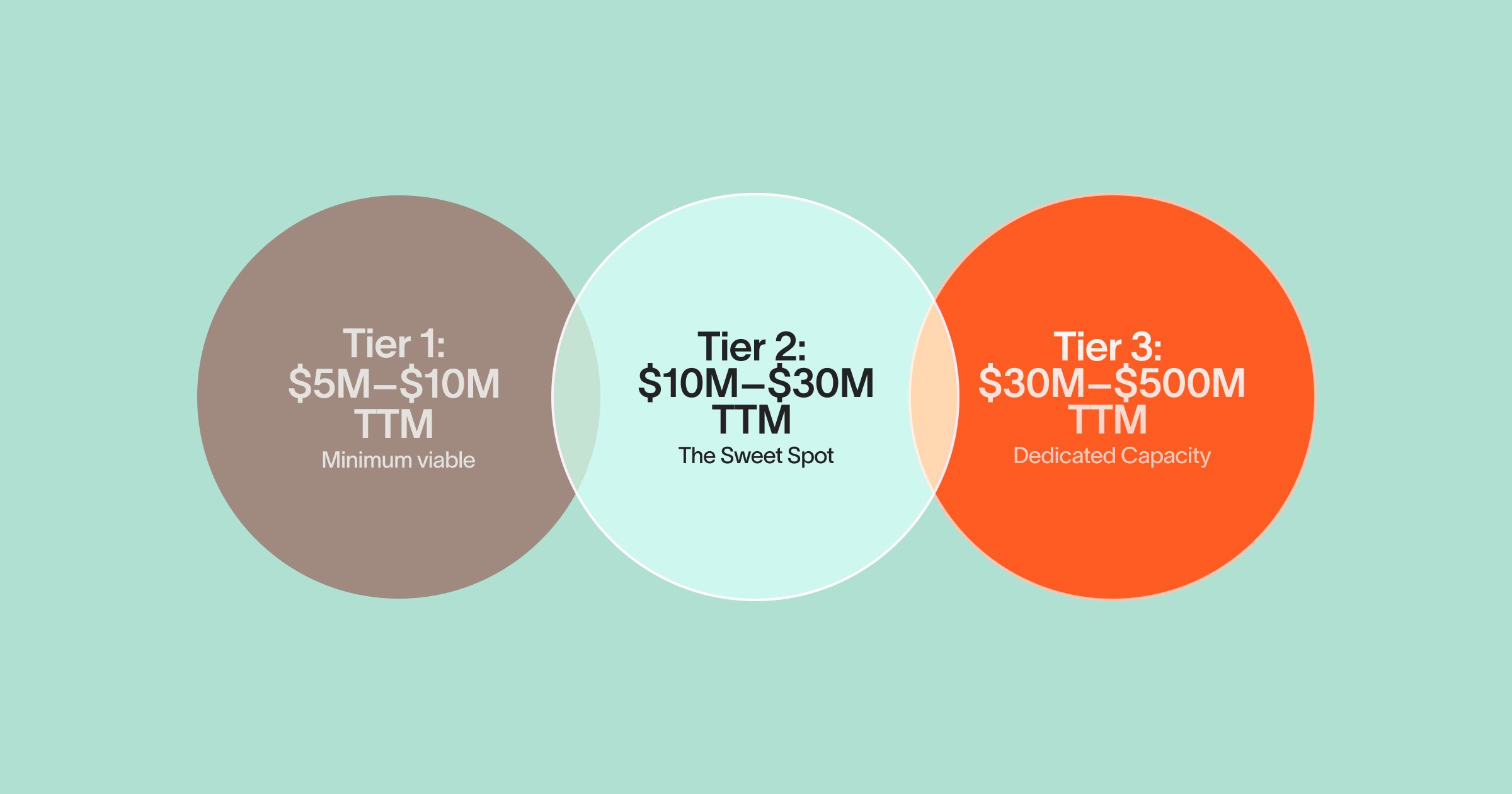
I use a framework called The 2P Readiness Ladder because the transition to 2P isn't a binary switch — it's a graduated scale where different things become possible at different revenue levels.
Tier 1: $5M–$10M TTM — Minimum viable. At this level, a 2P partnership is economically possible but constrained. The partner's wholesale margin on a $5M brand generates roughly $2M–$2.75M in gross revenue at retail (assuming 40–55% wholesale discount). After Amazon fees (typically 15–20% of retail), advertising (10–15% of revenue for CPG), and operational costs, the partner's operating margin is thin. This means:
The partner allocates a shared operator, not a dedicated one.
Tech deployment is standard — the brand gets the platform, not custom builds.
Channel expansion beyond Amazon is unlikely in year one.
SKU count matters more here. A 15-SKU brand at $5M is workable. A 200-SKU brand at $5M isn't — the per-SKU operational cost kills the unit economics.
Brands that work at this tier: high-margin categories (supplements, premium pet food, specialty beauty) with fewer than 30 SKUs and clean Amazon listings already in place.
Tier 2: $10M–$30M TTM — The sweet spot. This is where most 2P partners actively pursue brands. At $10M, the economics support a dedicated named operator, meaningful advertising investment ($80K–$150K/month on Amazon ads is typical at this level), and the margin pool to fund growth initiatives. You get proprietary tech fully deployed, multi-channel expansion (TikTok Shop, Walmart, DTC), and strategic investment from the partner — Vine reviews, Subscribe & Save subsidies, new ASIN launch budgets. Most brands in Neato's portfolio fall in this range.
Tier 3: $30M–$500M TTM — Dedicated capacity. At $30M+, the brand commands a dedicated multi-person team: named account lead, advertising specialist, content strategist, and direct access to partner leadership. The margin pool funds aggressive growth — new channel launches, international expansion, category adjacency testing.
Above $500M, brands often have the resources to build internally or run a hybrid model. The cost of a 2P partner's margin versus hiring a 15-person internal team starts to favor the build option.
What readiness signals matter beyond revenue?
Revenue is the threshold. But I've seen $12M brands that aren't ready for 2P and $6M brands that are. The difference comes down to four operational readiness signals.
1. Gross margin structure. A 2P partner buys at wholesale — typically 40–55% off retail. If the brand's COGS leaves gross margin below 50% before the wholesale discount, the math gets brutal. The brand sells to the partner at a price that must leave room for Amazon fees and advertising. High-COGS categories (fresh food, low-margin commodities) often don't work at any revenue level.
2. SKU rationalization. The operational cost of a 2P partnership scales with SKU count, not just revenue. A brand doing $10M across 15 hero SKUs has a very different cost profile than $10M across 150 SKUs with a long tail of slow movers. More SKUs means more content, more ad campaigns, more forecasting, and more chargeback exposure. Brands with fewer than 50 active SKUs are easier to onboard and more profitable to operate.
3. Category velocity on Amazon. Some categories convert at 15%+ on Amazon. Others sit at 3%. A brand in a high-velocity category (premium pet food, vitamins, beauty) can justify 2P at lower revenue thresholds because the advertising efficiency and conversion rates make the partner's economics work. A brand in a low-velocity category (niche home goods, artisan foods) needs higher revenue to compensate.
4. Operational readiness to hand off control. A 2P partner sets retail price, manages advertising, and makes inventory decisions. Brands that aren't ready to hand over operational control — founders who want to approve every keyword bid — create friction that erodes the value for both sides.
What categories have lower 2P thresholds?
The $5M minimum I quoted is an average. Some categories support 2P at lower revenue because the unit economics are better.
Supplements and vitamins: Gross margins of 65–80%, high Amazon conversion rates (12–18%), strong Subscribe & Save adoption, and relatively small packaging (low FBA fees). Brands in this category can be viable for 2P at $3M–$5M TTM.
Premium pet food: High repeat purchase rates, strong Amazon presence, and gross margins of 50–65%. The pet category on Amazon has grown 20%+ year-over-year for four consecutive years. Viable at $5M–$7M TTM.
Prestige beauty: High margins (60–75%) and strong brand loyalty, though SKU complexity (shades, sizes, bundles) pushes operational costs up. Viable at $5M–$8M TTM depending on SKU count.
Grocery and shelf-stable food: Lower margins (35–50%) and higher packaging weight (higher FBA fees). Typically requires $10M+ TTM.
Can a startup brand use a 2P partner?
The direct answer: not usually. A brand doing $1M–$3M doesn't generate enough margin for a 2P partner to cover operational costs. The math doesn't work at that scale.
What startups can do: work with an agency or 3P partner to build the Amazon channel to $5M+, then transition to 2P. The path from $0 to $5M is an agency problem — audience building, catalog optimization, review generation. The path from $5M to $50M is a 2P problem — operational scale, inventory management, channel expansion.
Some operators will tell a $2M brand they're "2P ready." If the PO size is below $50K per order and no named lead is dedicated, you're in an agency relationship with a different label.
The Neato point of view
Neato works with CPG brands doing $5M–$500M in trailing-12-month revenue, with our sweet spot at $10M–$100M. We're selective about onboarding below $10M because the economics need to work for both sides — and we'd rather tell a $6M brand "you're not ready yet, here's what to build first" than sign a deal that can't deliver for either party. The 2P Readiness Ladder isn't a sales filter. It's an honesty framework. The brands that reach out at $5M and hear "not yet" from us are the same brands that come back at $12M ready to compound.


