

I wrote a selection guide for choosing a 2P Amazon partner. It covered the mental model — what defines a 2P partner, how to think about the category, what red flags to watch for. This isn't that piece. This is the document you bring to the pitch meeting. The actual questions — worded for your RFP, structured for your diligence process — that separate a real operator from a deck with a logo on it.
An Amazon 2P partner RFP should include 15 due-diligence questions organized across four categories: deal structure, operational proof, technology and data, and exit and continuity. These questions are designed to surface contractual specifics, performance benchmarks, and operational evidence that a pitch deck won't show you — and that a partner who can't answer them hasn't built what they're selling.
I've sat on both sides of these meetings. When we were running our own brands, we asked questions that were too soft. When I started Neato, brands asked us questions that were too soft. The 15-Question Amazon Partner RFP below is what I wish every brand had in front of them. If a partner — including us — can't answer all fifteen, you don't have enough information to sign.
What should the deal-structure questions look like in an RFP?
The first four questions in the 15-Question Amazon Partner RFP are designed to nail down the contractual mechanics before you ever get to capabilities.
1. What is your exact legal entity that will issue purchase orders, and is it the same entity that will be the seller of record? Some operators route POs through one entity and sell through another — creating liability ambiguity. You want a single entity. Ask for the name, state of incorporation, and years in operation.
2. What is the term length, and what are the renewal and termination triggers? Get the initial term (12–24 months is standard), auto-renewal cadence, notice period for non-renewal, and termination-for-cause triggers on both sides. Auto-renewal clauses with 90+ day notice periods are designed to make switching expensive.
3. What performance guarantees are contractually committed — and what happens when they're missed? "We'll grow your revenue 30%" in a pitch deck means nothing without an SLA. Ask for minimum revenue thresholds, maximum ACOS targets, or inventory turn commitments in the contract — and the remediation when they miss.
4. Who carries product liability insurance on the inventory you hold, and what are the coverage limits? For CPG categories, minimum coverage is typically $2M–$5M per occurrence. Ask for the certificate of insurance. If they can't produce one within 48 hours, that's a diligence failure.

What operational proof should the RFP demand?
Questions five through nine go past the pitch deck and into operational evidence.
5. Provide your average chargeback dispute rate and recovery rate across your current portfolio for the trailing 12 months. The industry recovers roughly 60% of contestable chargebacks. Operators at 75%+ have built the dispute muscle. Ask for portfolio-wide and category-segmented numbers.
6. What is the average tenure and brand count of the named operator who will manage my account? Not the team — the individual. Years in Amazon operations, brands currently managed (6 or fewer is the benchmark), and category-specific experience. A lead managing 12 brands has half the attention yours needs.
7. Walk me through a real inventory write-down from the last 12 months — what happened, why, and what was the financial impact? Every operator has dead stock. You're looking for: a defined liquidation cadence, a return-to-brand threshold, and a financial accounting of the loss. An operator who says they've never had a write-down hasn't been operating long enough.
8. What was your average days-of-supply across your CPG portfolio last quarter? For CPG on Amazon, 30–45 days is optimal. Below 20 risks stockouts. Above 60 means excess. An operator who can't quote this number doesn't have demand planning infrastructure.
9. Show me a live MCF dashboard for one of your current brands. If the operator claims omnichannel fulfillment off Amazon's network, you should see shipments, channel breakdowns, and fulfillment times in a live screen-share — not screenshots.
What technology and data questions belong in the RFP?
Questions ten through twelve probe whether the operator has built real infrastructure or is running your account on spreadsheets and third-party tools.
10. What data do I own, in what format, and how do I get it if the partnership ends? Your sales data, advertising performance, keyword rankings, and inventory history should be contractually yours. Ask for the export format, the retention period post-termination (90 days minimum), and whether historical data survives the contract.
11. What decisions does your technology automate, and what still requires a human? Automated bid adjustments, inventory reorder triggers, chargeback dispute filing, listing suppression detection — what specifically runs without a person? If the answer is "our team uses the tools to make decisions," the tech is a dashboard, not an automation layer.
12. How do you attribute revenue across channels when my product is sold on Amazon, TikTok Shop, and DTC simultaneously? Ask for the attribution model: last-touch, first-touch, or blended? An operator who can't explain their attribution methodology will misallocate your ad spend across channels.
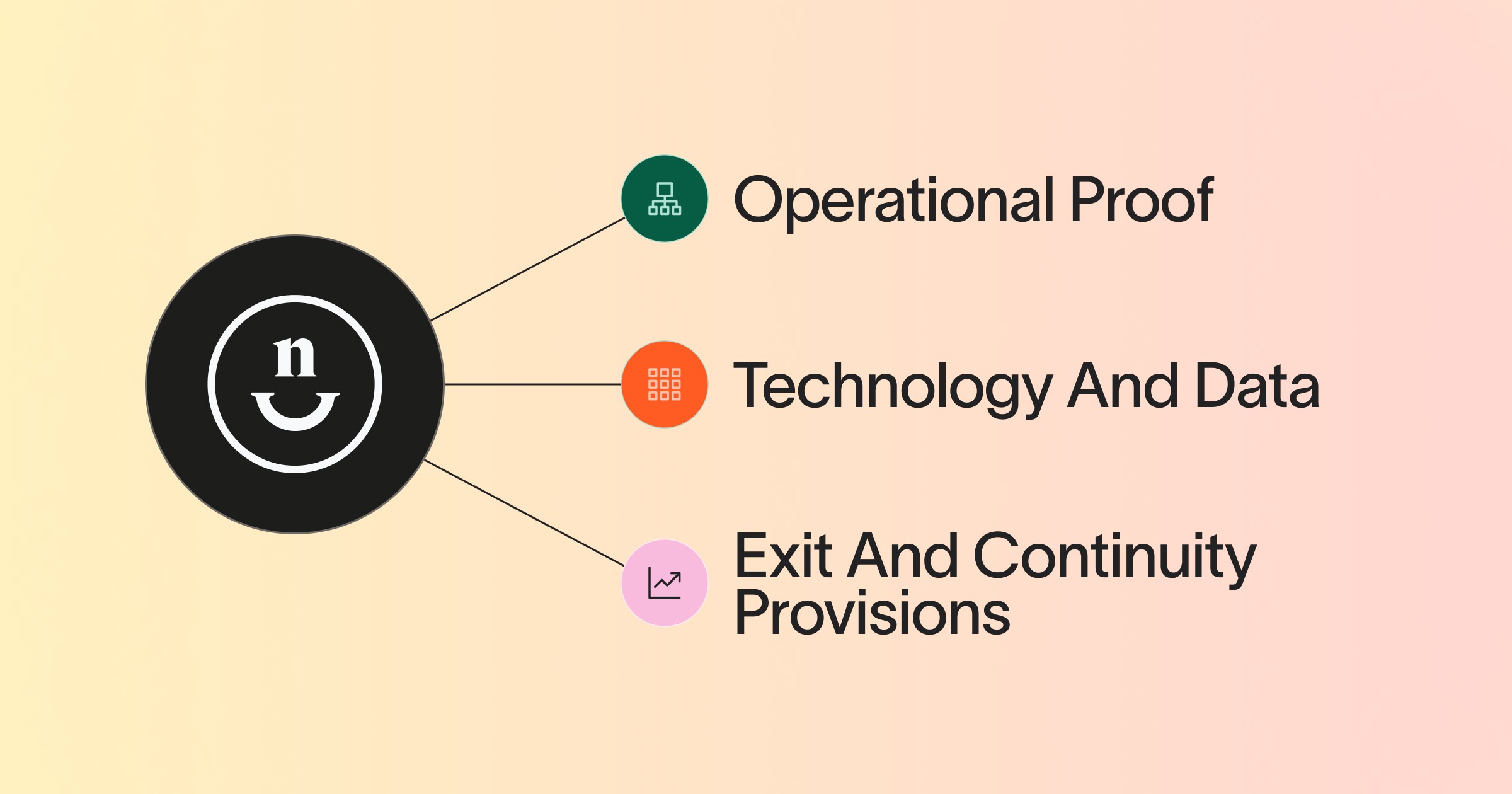
What exit and continuity provisions should the RFP require?
Questions thirteen through fifteen protect the brand when the relationship changes — planned or otherwise.
13. If your company is acquired or undergoes a change of control, what happens to my contract? Your contract should include a change-of-control clause giving you the option to terminate without penalty if ownership changes materially. Without it, you could end up in a partnership with an entity you didn't choose.
14. What is the complete off-boarding protocol, including timeline, for returning my brand to self-operation? Inventory buy-back or run-out terms, ASIN transfer, brand registry retention, data export, ad account handoff — with specific day counts for each step. A complete off-boarding should take 60–90 days. Longer quotes suggest embedded lock-in.
15. Will you provide three brand references that I select from your current portfolio — not references you pre-select? Ask the operator to share their brand list under NDA, then you choose three to call. The conversations you have with brands the operator didn't hand-pick tell you more than any pitch meeting.
The Neato point of view
We built the 15-Question Amazon Partner RFP because we answer it ourselves — every time. When a CPG brand comes to Neato, we hand them our legal entity documentation, chargeback recovery data by category, named operator resumes, a live MCF dashboard walkthrough, and our full off-boarding protocol before they ask. Brands who ask hard questions are brands who know what they're buying — and those are the only partnerships that compound. A partner who can answer all fifteen in two meetings has built the infrastructure. One who hedges on half of them hasn't.


