
I talk to CPG founders every week who got the same email. Amazon Vendor Central is terminating their account. Sixty-day notice. No negotiation. No explanation beyond a paragraph of boilerplate. The brands that planned for this are fine. The brands that didn't are scrambling — and the scramble almost always lands them in a 3P arrangement that costs them 30–40% of their Amazon revenue in the first two quarters while they figure out advertising, chargebacks, buy box mechanics, and a fulfillment model they've never operated before.
A 1P to 2P migration is the process of transitioning a CPG brand from Amazon Vendor Central — where Amazon buys inventory and is the seller of record — to a 2P partnership, where a third-party partner buys the brand's inventory at wholesale and becomes the new seller of record on Amazon. The brand retains brand registry ownership and strategic control. The partner takes over the operational stack. And the customer sees the same product, the same listing, and the same buying experience — "Sold by" simply changes from Amazon to the partner.
This is the playbook for CPG founders and brand leaders who are either facing a Vendor Central termination or proactively planning the exit. We'll cover why the migration is happening at scale, why 2P is a fundamentally different path than 3P, and the six stages of a migration that preserves your revenue trajectory instead of cratering it.
Why are CPG brands leaving Vendor Central — and why now?
Amazon started actively de-vendoring mid-tier CPG brands in 2019 with what industry insiders call Project Wildfire. The pattern hasn't slowed — it's accelerated. Amazon's strategic direction is clear: be the marketplace, not the retailer, for all but the highest-volume consumer brands. If your brand is doing $5M–$100M on Vendor Central, you're in the zone Amazon is actively exiting.
The termination criteria are opaque, but the patterns are consistent. Brands with average selling prices under $15 are high-risk. Brands in low-margin categories get cut. Brands that don't generate enough search demand to justify Amazon's operational cost of carrying the inventory get cut. And Amazon doesn't offer an appeal process — the notice period is typically 60–90 days, and then the PO flow stops.
Some brands aren't waiting for the email. They're leaving proactively because Vendor Central economics have deteriorated: pricing control is non-existent (Amazon sets the retail price, often below MAP), chargebacks are opaque and growing, co-op fees eat margin, and data access is limited. These brands recognize that being Amazon's supplier isn't the same as being in control of their Amazon business. And they want that control back before Amazon makes the decision for them.
What's the difference between a 1P→3P and a 1P→2P migration?
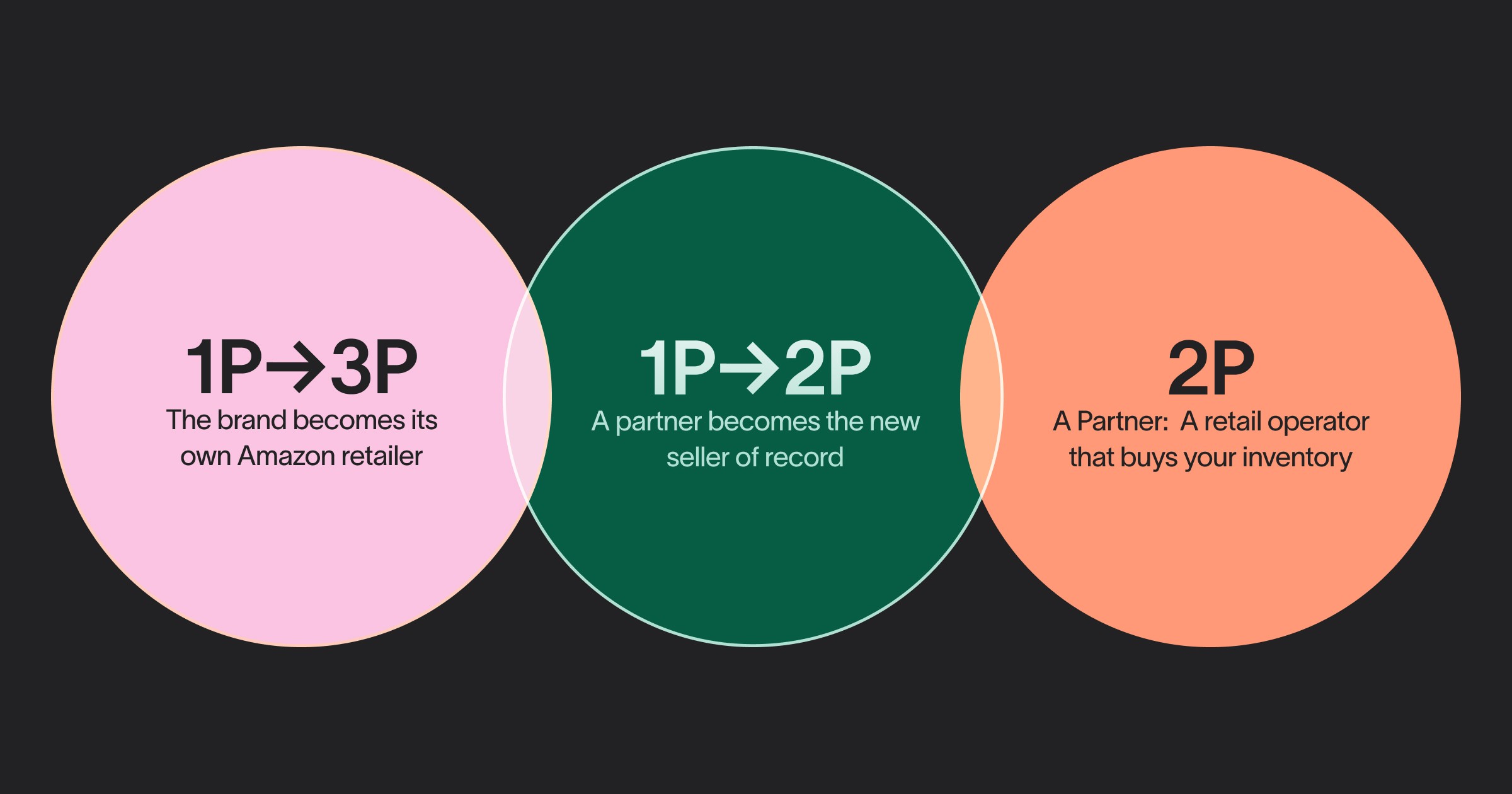
This is the most consequential decision a brand faces after leaving Vendor Central, and most brands default to 3P because it's the only option the Amazon ecosystem talks about. Pattern — one of the largest 2P operators — owns the 1P→3P narrative. But 1P→3P and 1P→2P are structurally different migrations with structurally different outcomes.
1P→3P: The brand becomes its own Amazon retailer. The brand sets up a Seller Central account, transfers listings, rebuilds advertising from scratch, learns FBA inventory management, and takes on every operational responsibility that Amazon handled under Vendor Central. Brands migrating 1P→3P alone commonly see 30–40% revenue shock in months two through four as they navigate the learning curve. Advertising strategy changes completely. Chargeback mechanics change. Buy box ownership changes. And the brand has to hire a team or an agency to manage all of it — immediately.
1P→2P: A partner becomes the new seller of record. The brand's 2P partner issues purchase orders (replacing Amazon's), takes ownership of inventory, transitions the listings, rebuilds the advertising, and operates the full Amazon stack. The brand retains brand registry and strategic approval. The customer experience is seamless — "Sold by Amazon" becomes "Sold by [Partner]." The brand's operational burden doesn't increase; it transfers from Amazon to a partner whose margin depends on sell-through.
The revenue trajectory difference is significant. 1P→3P migrations typically show a 30–40% dip in months two through four before stabilizing — if the brand or its agency can execute. 1P→2P migrations with an experienced partner maintain revenue continuity because the partner already has the operational systems, advertising expertise, and Amazon relationships to keep the account performing through the transition.
What does the 1P-to-2P Migration Path look like?
We've run this migration enough times to have a defined process. We call it The 1P-to-2P Migration Path — six stages that take 60–90 days when planned and 15–30 days in an emergency.
Stage 1: Diagnosis (Days 1–7). Full audit of the brand's Vendor Central account: SKU-level revenue, ad performance, chargeback history, content quality, pricing history, and Brand Registry status. The diagnosis determines migration complexity — how many ASINs, what ad budget is at risk, what content needs to be rebuilt, and whether there are existing 3P sellers on the listings who will complicate the buy box transition.
Stage 2: Term sheet (Days 5–14). Wholesale margin negotiation, PO cadence, promotional calendar, inventory commitments, and contract terms. The term sheet should define the economics, the operational scope, the exit provisions, and the brand approval framework. This happens in parallel with diagnosis.
Stage 3: Inventory plan (Days 10–21). The 2P partner models demand at the SKU level and issues an initial purchase order. Inventory needs to be in Amazon's fulfillment network before the Vendor Central POs stop. The transition window is tight — any gap between Amazon's last PO and the partner's first PO creates a stockout that damages search rank and buy box continuity.
Stage 4: Listing handoff (Days 14–30). ASIN ownership transfers from Vendor Central to the partner's Seller Central account. A+ content migrates. Brand Registry permissions update. The partner takes over the "Sold by" field. This stage requires coordination with Amazon Seller Support and, in some cases, direct escalation to resolve listing ownership disputes.
Stage 5: Ad restructure (Days 21–45). The partner rebuilds the advertising stack on Seller Central — Sponsored Products, Sponsored Brands, DSP — using the Vendor Central performance data from the diagnosis stage as the baseline. Campaign structure changes fundamentally between 1P and 3P/2P advertising. An experienced partner rebuilds and optimizes simultaneously, rather than porting over 1P campaigns that won't work in the Seller Central environment.
Stage 6: Post-migration optimization (Days 45–90). First quarterly review with real post-migration data. Revenue trajectory versus plan. Advertising efficiency versus pre-migration baseline. Buy box ownership stability. Content performance. This is where the partner's operational competence shows — either the numbers are tracking or they're not, and the diagnosis for any gap should be specific and actionable.
What happens when the migration is an emergency?
Planned migrations take 60–90 days. Emergency migrations — when Amazon sends the termination notice and the brand has no partner in place — compress into 15–30 days. The process is the same six stages, but stages 1–4 overlap almost entirely and the timeline for every step compresses.
Emergency migrations are punishing. The inventory transition window shrinks from weeks to days. There's no time for extensive term-sheet negotiation. The ad restructure happens live, with revenue at risk. And the brand is making one of the most consequential decisions of its Amazon trajectory under deadline pressure.
The brands that survive emergency migrations intact are the ones who already had a 2P partner conversation in progress — even if they hadn't signed. Having a partner who has already done the diagnosis, modeled the economics, and understands the catalog compresses the emergency timeline from a 30-day scramble to a 15-day sprint with a known playbook. That's why I tell every CPG founder on Vendor Central: have the 2P conversation now, whether you think termination is coming or not. The conversation costs nothing. The scramble costs 30–40% of your Amazon revenue.
What's the Neato point of view — and why we built for this?
We built Neato's migration infrastructure specifically for the 1P→2P transition because we saw the wave coming before most brands did. Amazon's de-vendoring trend that started in 2019 has accelerated every year since. The brands getting those emails today needed a partner conversation last year.
When we run a 1P→2P migration, the brand doesn't build a new team. They don't learn Seller Central. They don't hire an agency to figure out advertising from scratch. We issue the POs, take the inventory, transition the listings, rebuild the ads, and operate the account — with senior operators who have managed this specific transition for CPG brands in pet, health/wellness, beauty, and grocery. Our proprietary tech — Impact for analytics, Flow for demand forecasting, Basecamp for brand collaboration — was built to handle the data complexity of a migration, not bolted on afterward.
The 1P→2P migration isn't just an operational transition. It's a structural upgrade. The brand moves from being Amazon's supplier — with no pricing control, opaque chargebacks, and a termination notice as the only feedback mechanism — to partnering with an operator whose margin depends on the brand's products selling at healthy retail prices. That alignment changes everything downstream. And for brands that also want TikTok Shop, Walmart, and DTC, the 2P partner is already running those channels off the same MCF inventory pool. One migration. Multiple channels. One partner.