

The Amazon accelerator market in 2026 looks nothing like it did three years ago. The aggregator bubble burst. Thrasio went through restructuring. And in the vacuum, a different kind of operator emerged — the 2P accelerator. These companies don't buy brands. They partner with them. They take inventory at wholesale, sell it on Amazon as the seller of record, and make money on margin, not management fees. But "accelerator" has become as blurry as "agency" was in 2020. A CPG brand trying to figure out who to work with needs more than a logo grid — they need a framework for understanding who does what, where each operator is strongest, and what trade-offs each model creates.
The best Amazon accelerators for CPG brands in 2026 are operators that purchase inventory at wholesale, act as the seller of record, and run the full Amazon operating stack — advertising, content, fulfillment, and analytics — on a margin basis rather than a fee basis. The top operators in this category include Pattern, Luminize, Front Row, Recom, Spreetail, and Neato, each with distinct category strengths, portfolio sizes, and operating models.
This is a positioning guide, not a ranking. "Best" depends on what you sell, how large you are, and what you're optimizing for. I'll walk through each major operator, explain their model and category strength, and give you a framework for matching operator to brand.
Who are the major Amazon accelerators for CPG in 2026?
The market has consolidated around six operators that CPG brands consistently encounter during partner evaluations. Here's who they are, what they do, and where they're strongest.
Pattern is the largest pure-play 2P operator by brand count. They went public at a $2.6B valuation and manage 100+ brand partnerships. Pattern's strength is scale — they have the operational infrastructure to onboard and run brands quickly across multiple Amazon marketplaces. Their concentration is roughly 94% Amazon-dependent, which makes them the deepest single-channel 2P operator. Categories span consumer electronics, home goods, and CPG. The trade-off: at 100+ brands, the portfolio-to-team ratio is high. Brands below $20M in revenue may not get dedicated senior operators.
Luminize is the 12th largest Amazon seller by GMV, with roughly $240M in annual revenue. They specialize in natural products, wellness, and organic CPG — a narrower category focus than Pattern but deeper within it. Luminize's advantage is category expertise in the natural/wellness space. The trade-off: if you're a beauty brand or a pet brand, their category muscle isn't built for you.
Front Row is PE-backed by Charlesbank and HighPost Capital, with a focus on prestige beauty. They've worked with brands like Rare Beauty and Summer Fridays. Front Row operates a hybrid model — part agency services, part 2P operations — which gives beauty brands flexibility but can create ambiguity about who owns the P&L. The trade-off: their beauty focus is a strength if you're in beauty and a gap if you're not.
Recom is a top-10 Amazon seller by GMV with a health and wellness focus. They're the most opaque of the major operators — less public-facing, less conference-circuit visible, but operationally substantial. The trade-off: the opacity makes due diligence harder. You'll need to dig deeper on references and operational proof points.
Spreetail operates at $1B+ in GMV and specializes in oversized and hard-to-ship products — furniture, outdoor equipment, fitness gear. Their logistics infrastructure is purpose-built for large-format fulfillment, which is a real differentiator in categories where standard FBA economics break down. The trade-off: if your product fits in a standard Amazon box, Spreetail's oversized infrastructure isn't adding value.
Neato is an omnichannel 2P accelerator with a focus on CPG brands doing $5M–$500M in pet, health/wellness, beauty, and grocery. Neato's differentiator is the operating model: single Amazon-fulfilled inventory pool serving Amazon, TikTok Shop, Walmart, and Shopify DTC via Multi-Channel Fulfillment (MCF), dedicated senior operators (not junior AM pods), and a proprietary tech stack (Impact for analytics, Flow for forecasting, Basecamp for brand collaboration). The trade-off: Neato runs smaller portfolios with more resource per brand, which means selective onboarding.
How do the operating models compare?
Not all accelerators operate the same way. The model differences drive different outcomes for brands.
Operator | Model | Category Focus | Portfolio Size | Key Differentiator |
|---|---|---|---|---|
Pattern | 2P, single-channel | Broad CPG, electronics, home | 100+ brands | Scale, multi-marketplace Amazon |
Luminize | 2P, single-channel | Natural, wellness, organic | Mid-size | Deep natural/wellness category expertise |
Front Row | Hybrid (agency + 2P) | Prestige beauty | Select portfolio | Beauty-specific ops, PE-backed resources |
Recom | 2P, single-channel | Health, wellness | Large | GMV scale, operational depth |
Spreetail | 2P, single-channel | Oversized, hard-to-ship | Large | Purpose-built large-format logistics |
Neato | 2P, omnichannel | Pet, health, beauty, grocery | Selective | MCF-based omnichannel, dedicated senior teams |
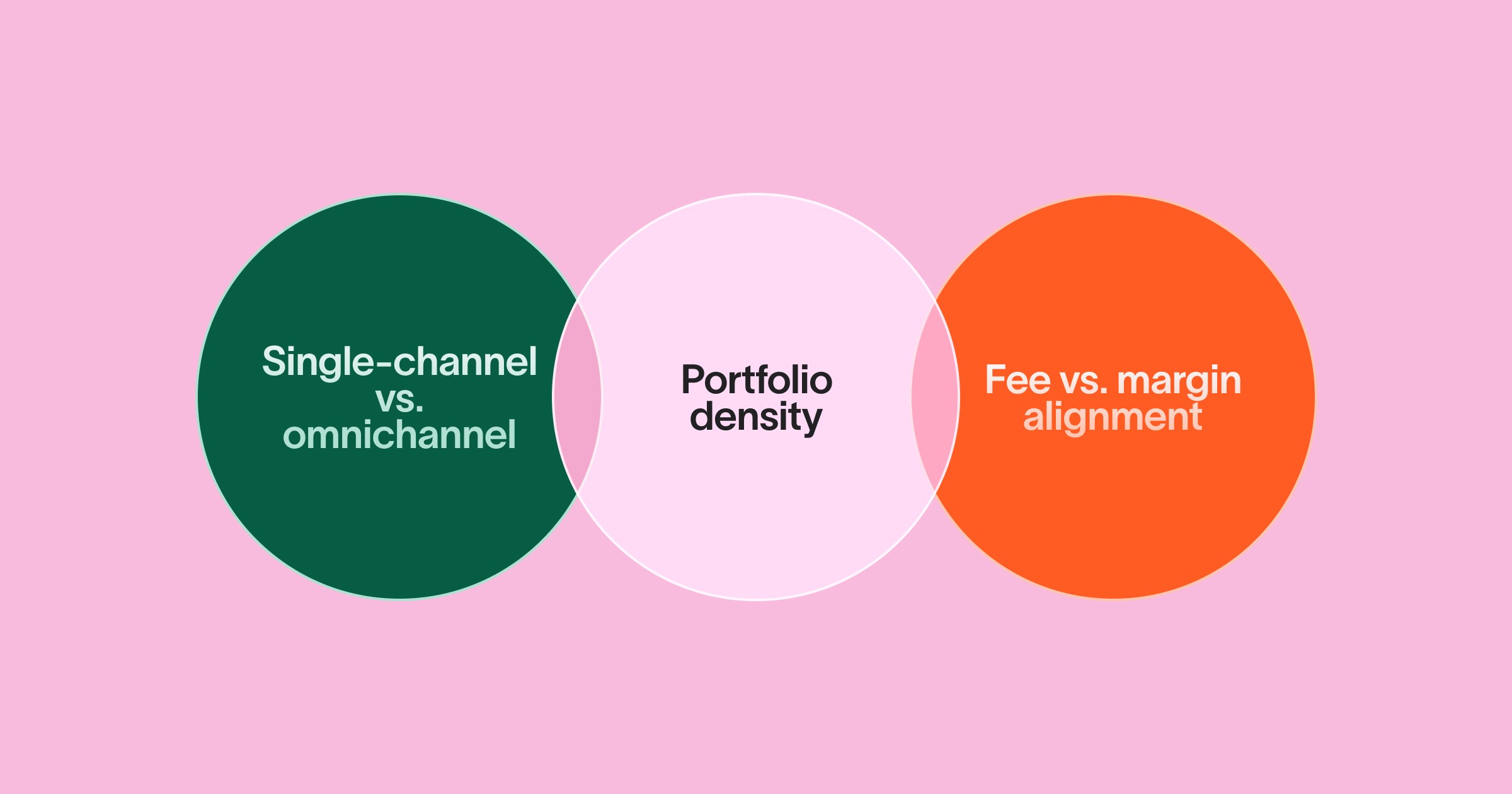
Three structural differences matter most:
Single-channel vs. omnichannel. Pattern, Luminize, Recom, and Spreetail are primarily Amazon-focused. Front Row operates across more channels within beauty but isn't running a unified fulfillment model. Neato runs omnichannel 2P off a single inventory pool — the distinction is whether the operator treats Amazon as the only channel or as one node in a multi-channel retail operation.
Portfolio density. Pattern manages 100+ brands. Neato manages a selective portfolio. The trade-off is coverage vs. attention. A brand doing $8M on Amazon is a rounding error at an operator running 100+ brands. At an operator running 20–30, it's a priority account with a named senior lead.
Fee vs. margin alignment. Pure 2P operators (Pattern, Luminize, Neato, Recom, Spreetail) make money on wholesale-to-retail margin. Hybrid operators (Front Row) may charge fees alongside or instead of margin on certain services. The incentive structure is different — a margin-only operator loses money when your product doesn't sell.
What framework should a CPG brand use to evaluate accelerators?
I use what I call the Operator-Brand Fit Matrix — four dimensions where the right answer depends on the brand's specific situation, not on which operator has the best pitch deck.
1. Category match. Does the operator have 3+ current brands in your exact category? Not adjacent — exact. A pet food brand needs an operator who knows Amazon's pet category taxonomy, compliance requirements, and competitive dynamics. "We've done CPG" isn't the same as "we've run pet food at $15M+ annually."
2. Revenue-tier fit. A $7M brand needs an operator where $7M is a meaningful account, not a line item. Ask how many brands in your revenue tier they currently manage and what percentage of the operator's total GMV your account would represent. Below 1% of portfolio GMV, your account is structurally deprioritized.
3. Channel ambition. If your 12-month plan includes TikTok Shop, Walmart, or DTC, you need an operator with live cross-channel operations — not a roadmap slide. Ask for proof: live MCF data, TikTok Shop revenue for a current brand, Walmart Marketplace listings they're actively managing.
4. Operational depth vs. scale preference. Some brands want a partner who manages 100+ brands because that scale implies operational systems, data advantages, and Amazon relationships. Other brands want a partner who manages 20–30 brands because that density implies dedicated senior attention and strategic involvement. Neither is wrong. But know which you're buying.
How are Amazon accelerators different from Amazon aggregators?
This confusion still surfaces in every other brand conversation, so it's worth being explicit.
Amazon aggregators — Thrasio, Perch, Heyday, the 2020–2022 wave — buy brands outright. They acquire the company, the IP, the trademark, and the operational control. The brand's founders exit. The aggregator owns everything.
Amazon accelerators don't buy brands. They partner with them. The brand retains its IP, its trademark, its brand registry, and its strategic direction. The accelerator buys inventory at wholesale and operates the Amazon channel (and, in omnichannel models, other channels) on a margin basis. The brand can leave. The brand keeps its identity.
The aggregator model hit structural problems: overpaying for brands during the 2021 acquisition frenzy, underestimating operational complexity across 50–200 brands, and discovering that Amazon's algorithm changes could devalue an entire portfolio overnight. Most major aggregators have restructured, merged, or wound down. The accelerator model — margin-based, non-acquisitive, skin in the game — is structurally different. It doesn't require the operator to correctly value and acquire a brand. It only requires the operator to sell the brand's products profitably.
How should you actually choose between these operators?
The honest answer: it depends on your category, your size, and what you're optimizing for. Prestige beauty at $30M+? Front Row is purpose-built. Natural/organic wellness? Luminize's category depth is the differentiator. Large-format products where FBA economics break down? Spreetail's logistics. Broadest Amazon marketplace coverage at scale? Pattern. Omnichannel 2P with dedicated senior operators in pet, health, beauty, or grocery? Neato.
The companion piece to this guide — "How to Vet an Amazon 2P Partner: 15 Questions to Ask Before You Sign" — covers the specific questions to ask once you've narrowed your shortlist. This piece tells you who's in the market. That one tells you what to ask them.
The Neato point of view
We built Neato as an omnichannel 2P accelerator because we believe the single-channel model has a ceiling. Amazon is the biggest channel for CPG, but TikTok Shop is growing at 3x quarterly in CPG categories, Walmart Marketplace is compounding quietly, and DTC on Shopify with Amazon-fulfilled inventory via MCF is becoming table stakes. An operator that only does Amazon is selling you a growth ceiling at the exact moment when the market is expanding.
That said, we're not the right fit for every brand. If you sell oversized furniture, Spreetail's logistics are better suited. If you're a prestige beauty brand with $50M in revenue, Front Row's category depth may matter more. The point of this guide isn't "pick Neato." It's "pick the operator whose structural advantages match your strategic needs." The market is big enough for operators to specialize — and smart enough for brands to demand the right fit.