
Stop Blaming Your Campaigns
I pulled a search term report last week for a brand spending $50K/month on Amazon ads. Their TACOS had crept from 10% to 18% over three quarters. The brand director wanted a campaign audit.
I looked at the data for about ten minutes and knew the campaigns weren't the problem.
Their branded search share was 4%. Four percent. In a category where the top performers sit at 30%+.
That's not an ad efficiency issue. That's a brand awareness issue. And I see this exact pattern every single week.
Quick Reality Check on the Ad Market
Amazon’s advertising business crossed $56 billion in revenue in 2025. Average CPC in competitive categories — supplements, pet food, beauty — has pushed past $1.80. Some keywords clear $4.00. ROAS has compressed year over year for five consecutive quarters across most categories tracked by Amazon Growth Lab.
The auction is more expensive every quarter. If your only response is to restructure campaigns, you’re optimizing within a shrinking box.
What TACOS Actually Tells You
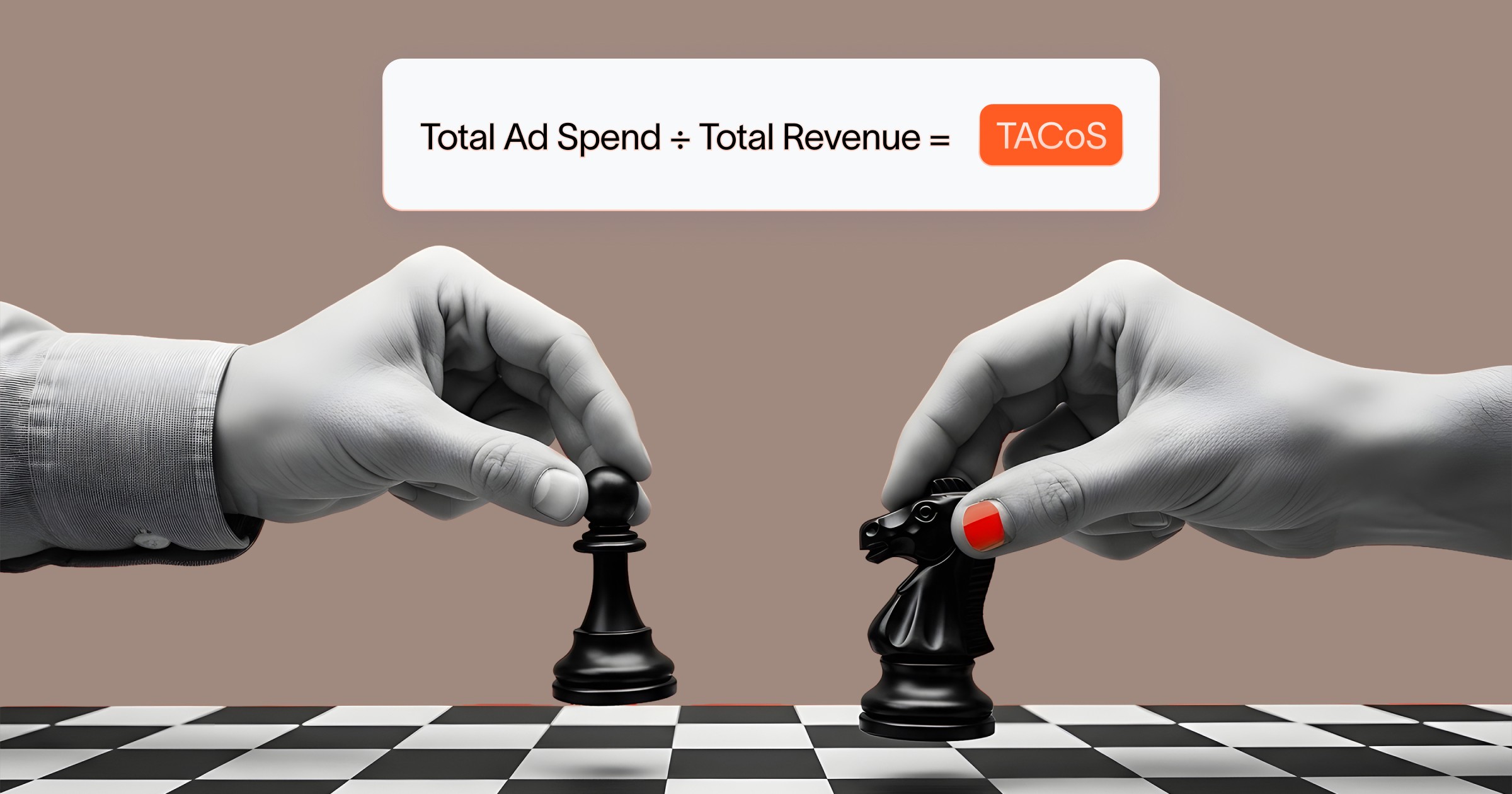
Quick math: total ad spend ÷ total revenue = TACOS.
But here’s what most people get wrong — “total revenue” shouldn’t just mean Amazon revenue. The real power of TACOS is when you measure it across your entire business: Amazon sales (ad-attributed and organic), DTC website revenue, and retail sales. That’s the full picture.
When TACOS rises, it’s usually not because you’re spending more. It’s because your total revenue — especially organic and cross-channel revenue — is shrinking relative to paid. Most people stare at the numerator when the denominator is the real problem.
Brands with real off-Amazon awareness — running social, influencer programs, PR, retail — consistently operate at 5–8% TACOS when measured against total omnichannel revenue. Even on an Amazon-only basis, these brands sit at 8–10% in categories where the average is 15–20%+. That gap has nothing to do with bid strategy. Those brands’ customers already know them before opening the Amazon app.
The ACOS Trap
Before we go further, let’s talk about why so many brands are stuck in the first place.
When brands optimize solely for ACOS (Advertising Cost of Sale), they fall into a predictable pattern:
They cut top-of-funnel spend. Sponsored Brands and Sponsored Display ads have higher ACOS — but they drive the most brand awareness and halo effect. Cutting them saves money on paper while destroying long-term growth.
They chase low-ACOS keywords only. Branded keywords have great ACOS, but they don’t grow the customer base. You’re preaching to the choir.
They miss the organic flywheel. Ad-driven sales velocity improves organic rank, which drives free sales. Cutting spend breaks this cycle.
They ignore off-Amazon impact. ACOS can’t see the DTC traffic or retail lift your Amazon presence generates.
A “good” ACOS with declining total revenue is not success — it’s a warning sign.
ACOS tells you the efficiency of individual campaigns. TACOS tells you whether your advertising strategy is actually growing your brand. They’re fundamentally different questions. TACOS captures organic sales lift, cross-channel revenue, true ad efficiency, and investment confidence that ACOS simply cannot.
The Amazon Halo Effect
Here’s the concept that changes everything about how you should think about TACOS: the Amazon Halo Effect.
When a customer discovers your brand through Amazon advertising, that awareness doesn’t stay on Amazon. It radiates outward — driving direct website visits, in-store purchases, and repeat buying across every channel.
The research backs this up. 64% of Amazon shoppers research products on Amazon before buying elsewhere. Brands see a 2–3x lift in branded Google searches after running Amazon ad campaigns. And 42% of in-store CPG purchases are influenced by online research — much of which starts on Amazon.
Here’s how it works in practice:
Amazon → DTC: A customer sees your Sponsored Products ad, views your listing, absorbs your brand messaging and social proof. Later, they search your brand name on Google — driving organic DTC traffic at zero marginal cost. They buy directly from your website at higher margins.
Amazon → In-Store: Your ad-driven visibility keeps you top-ranked in Amazon search. Reviews build social proof. When that same customer sees your packaging on a retail shelf, they recognize you and choose you over competitors with confidence.
And the flywheel spins both ways. DTC customers leave Amazon reviews after repurchasing via Subscribe & Save. In-store displays drive Amazon QR code scans. Retail velocity signals boost Amazon organic ranking. Every channel reinforces every other channel.
This is why TACOS measured across all channels is the metric that matters.

The Branded Search Math
When someone searches your brand name instead of a category keyword, everything changes:
Conversion rate: 2–4x higher than generic searches. Amazon’s algorithm notices immediately.
CPC: A branded bid might be $0.40. The generic category keyword? $2.50. That’s 6x cheaper.
Organic rank effect: Higher CTR and conversion velocity feed A10. Your organic position rises without additional spend.
TACOS impact: More organic revenue in the denominator. No additional ad spend in the numerator. The ratio compresses mechanically.
The One Question That Matters
Next time TACOS comes up in a review, skip the campaign deep-dive. Ask this instead:
"What percentage of our Amazon traffic comes from branded searches?"
Below 20%? You don't have an ad problem. You have a brand problem. No amount of campaign restructuring changes that math.
And here's the question after that: "Are we investing across the full advertising funnel — or just optimizing the bottom?"
Because TACOS compression doesn't come from squeezing more efficiency out of existing campaigns. It comes from the halo effect — building a brand that customers seek out across every channel, and running a full-funnel strategy that makes that happen.
Frequently Asked Questions
What is a good TACOS percentage on Amazon?
On an Amazon-only basis, brands with strong off-Amazon awareness and full-funnel advertising strategies typically operate between 5–10% TACOS. Category averages often sit between 15–20%. When measured across total omnichannel revenue (Amazon + DTC + retail), healthy TACOS can be even lower. If your TACOS exceeds your category average, brand recognition and funnel balance — not campaign structure — are likely the bottleneck.
How is TACOS different from ACOS on Amazon?
ACOS (Advertising Cost of Sale) measures the efficiency of individual ad campaigns: ad spend divided by ad-attributed revenue. TACOS (Total Advertising Cost of Sale) divides total ad spend by total revenue, including organic sales and ideally cross-channel revenue. TACOS is the better health metric because it captures how well your brand converts without paid support and reveals the full impact of your advertising investment — including the halo effect on DTC and retail.
Can you lower Amazon TACOS without increasing ad spend?
Yes. There are two key levers. First, rebalancing your existing ad spend across the full funnel — investing in Sponsored Brands and Display for awareness rather than concentrating only on Sponsored Products for conversion. Second, driving branded search through off-Amazon channels — social media, influencer programs, PR, and retail presence — which increases organic revenue without additional ad spend. Both approaches lower TACOS by expanding the revenue denominator.
Why does branded search matter for Amazon TACOS?
Branded searches convert at 2–4x the rate of generic searches, cost far less per click, and generate organic ranking signals that compound over time. Brands with high branded search share achieve structurally lower TACOS because a larger share of their revenue comes without advertising cost. And because of the halo effect, that branded awareness also drives DTC and retail revenue — further expanding the total revenue denominator.
What is the Amazon Halo Effect?
The Amazon Halo Effect is the phenomenon where Amazon advertising drives revenue beyond Amazon itself. When customers discover your brand through Amazon ads, that awareness radiates outward — they search your brand on Google, visit your DTC website, and recognize your packaging in retail stores. Research shows 64% of Amazon shoppers research on Amazon before buying elsewhere, and brands see 2–3x lifts in branded Google searches after Amazon ad campaigns. The halo effect works in reverse too: DTC marketing and retail presence feed Amazon search volume and sales velocity.


