
The 2P model is a commerce structure in which a inventory, becomes the seller of record, and runs every ecommerce channel as its own business, with its own capital on the line. For brands caught between Amazon’s rigid 1P terms and the operational chaos of 3P, it’s the structural alternative the market has been missing.retail operator purchases your
Most brands managing Amazon find themselves trapped between imperfect options: four separate vendor relationships across advertising, creative, fulfillment, and DTC, fragmented accountability, and uncomfortable compromises they call a strategy. The 2P retail operator model changes the equation: one partner who purchases your inventory, owns the P&L, and runs the entire channel as their own business, with their own capital on the line.
1P vs. 3P vs. 2P Compared
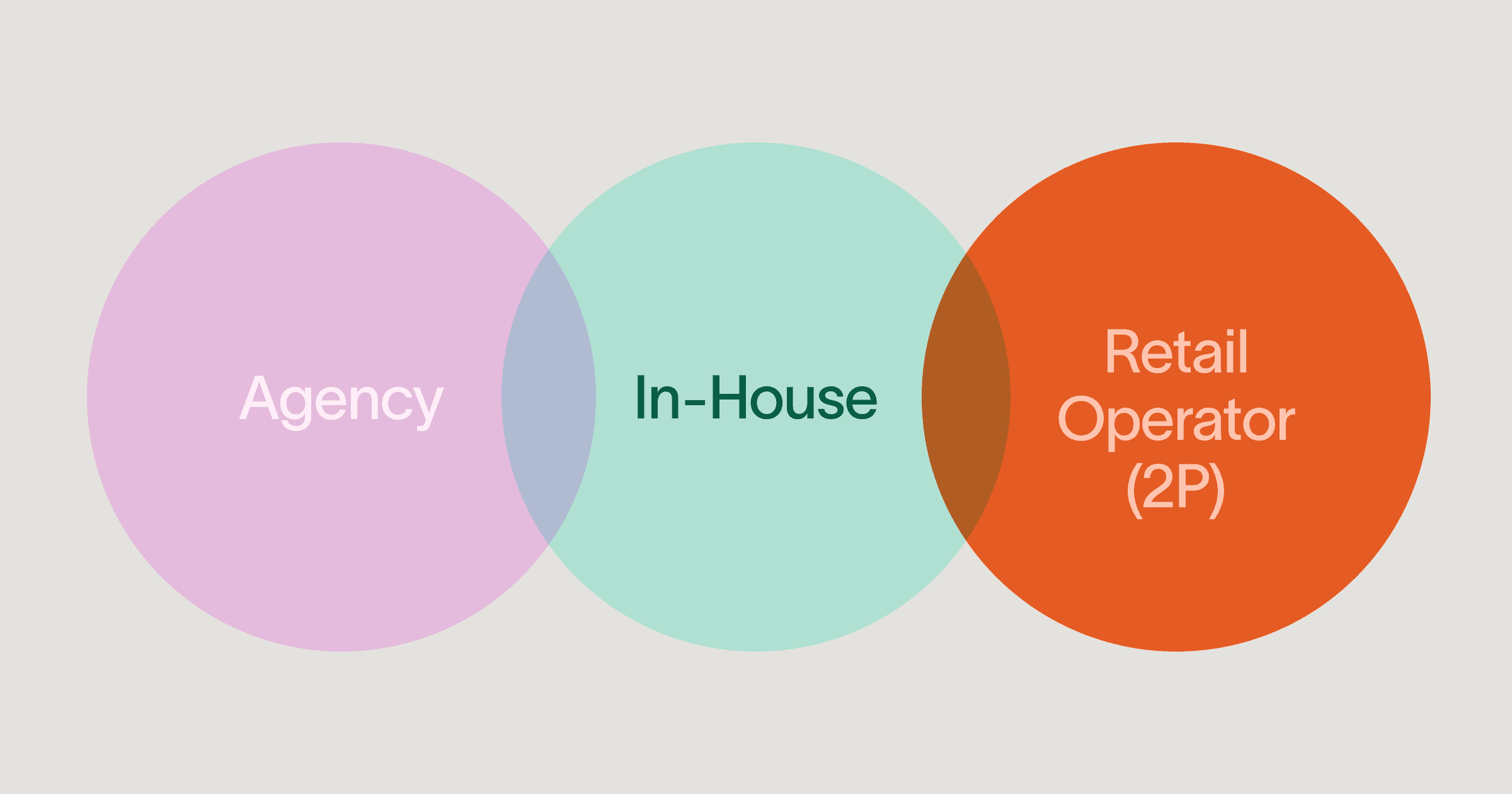
1P Is Rigid. 3P Is Chaotic. There's a Third Path.
Four models exist for managing a commerce operation. Each one distributes inventory risk, operational accountability, and incentive alignment differently, and those differences determine everything.
1P (Vendor Central): Amazon Owns It
In the 1P model, Amazon buys your inventory, becomes the seller of record, and runs your channel on its own terms. For years, this felt like simplicity: one relationship, no operational overhead. The catch: Amazon owned the pricing, the customer relationship, and the margin. And starting November 2024, Amazon began systematically terminating 1P relationships with thousands of established CPG brands, leaving them responsible for a channel they had never actually operated. 1P was never a strategy. It was a dependency.
3P (Agency Model): Advice Without Accountability
The most common response to losing 1P is hiring an agency, or several. One for Amazon advertising, another for creative, a 3PL for fulfillment, a separate DTC team. This is how a single agency relationship quietly becomes a vendor stack, and how a vendor stack quietly becomes your full-time job. In every 3P variant, the brand remains the seller of record. The agency files a ticket. The vendor sends an update. It all lands back on you.
2P (Retail Operator): One Partner, One P&L, Every Channel
A 2P retail operator is a different category of partner entirely. Not an agency. Not a 3PL. Not a managed service.
A 2P retail operator purchases your inventory at wholesale, becomes the seller of record across every channel you operate, and runs the entire commercial system as its own business: pricing, content, advertising, fulfillment, brand protection, and customer experience.
The critical distinction is not operational scope. It's incentive structure. When a partner owns inventory, they own the outcome. Their revenue comes from selling your products profitably, not from billing hours or marking up ad spend. That alignment changes every decision they make, across every channel they operate. No retainers. No percentage-of-ad-spend fees. No management charges. Purchase orders only.
Your brand stays in your hands. You set brand guidelines, approve creative direction, and define pricing floors. Nothing goes live without your sign-off. The operator runs within your guardrails, with their own money on the line.
Agency | In-House | Retail Operator (2P) | |
|---|---|---|---|
Owns inventory risk | No | Brand's capital | Yes |
Seller of record | Brand | Brand | Operator |
Owns the outcome | Escalates to you | Yes | Yes (fully) |
Incentive alignment | Fee-based | Internal politics | Shared P&L |
Channels managed | Usually Amazon only | Depends on headcount | Amazon, Walmart, TikTok Shop, DTC |
Creative + ops integrated | Rarely | Expensive | Always |
Brand protection | Billable service | DIY | Core function |
What you pay | Retainer + % ad spend | Salaries + overhead | Purchase orders only |
Why CPG Brands Are Switching
Why Leading CPG Brands Are Embracing 2P
Brands adopting the 2P retail operator model consistently experience structural improvements, not because 2P operators are more talented than agencies, but because the incentive structure demands different decisions.
Protected Margins and Price Stability
Under 2P, you eliminate the hidden costs associated with Vendor Central and shield your products from unauthorized resellers that erode your pricing strategy. Because the retail operator is the seller of record, their revenue is directly affected by unauthorized seller activity, creating genuine urgency that a fee-based agency structurally cannot replicate.
No Rev-Share. No Management Fees. No Surprises.
The financial model is simple: you sell inventory at wholesale. The operator owns the P&L from there. No monthly retainers, no percentage-of-ad-spend markups, no platform fees. Predictable cash flow on purchase order terms.
Operational Freedom Across Every Channel
All marketplace operations, from inventory forecasting and listing optimization to advertising, customer service, and compliance, are handled by your 2P operator. Not across four separate vendors, but from one integrated team running one P&L. 98% of online sellers now operate across multiple channels. The coordination that requires is something the agency model was never designed for.
Brand Integrity at Scale
Your brand story, positioning, and premium identity remain consistently communicated across all channels. The operator produces photography, video, and design in-house, and your strategic approval governs how the brand shows up everywhere.
Real Results, Named Brands
Earth Animal, a premium pet wellness brand, partnered with Neato and achieved +204% year-over-year revenue growth with a 5.8-point conversion rate lift. Wiley Wallaby saw +168% YoY revenue growth after repositioning sampler packs as the primary acquisition driver. illy recovered +29 points of Buy Box control while maintaining premium pricing, without discounting.
These outcomes aren't agency magic. They're the structural result of a partner whose margin depends on selling your products profitably.
Is 2P Right for You?
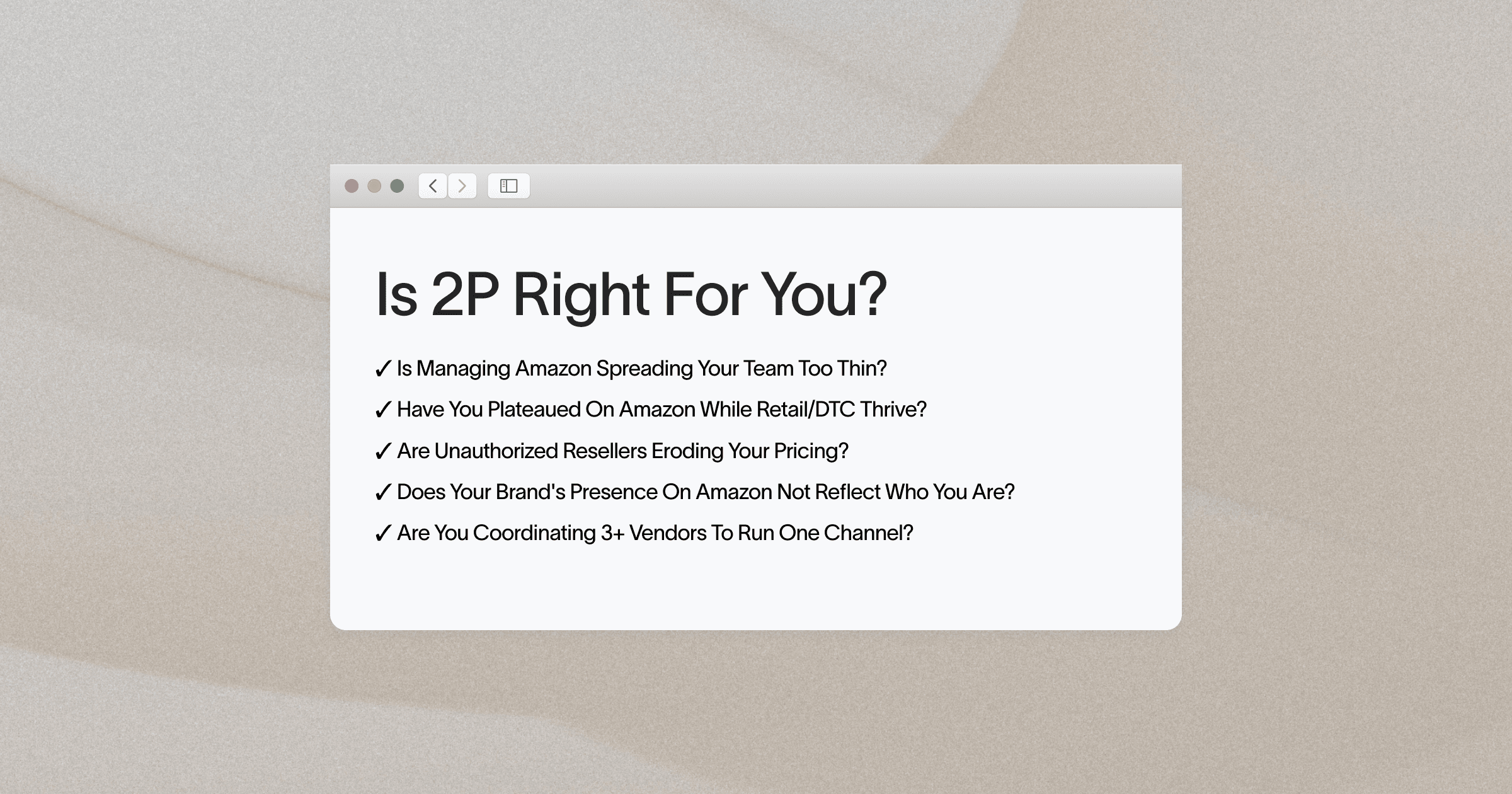
Evaluating whether 2P aligns with your strategic objectives involves honestly assessing your current commerce structure:
Is managing Amazon (or multiple channels) internally spreading your resources too thin, affecting your core business?
Has your Amazon growth plateaued despite strong consumer demand and successful retail or DTC channels?
Do you consistently face issues with price erosion, unauthorized resellers, or diluted brand presentation?
Would your team benefit from redirecting time spent on vendor management toward innovation and strategic planning?
Are you coordinating three or more separate vendors to run what should be one integrated operation?
If you answered "yes" to any of these, a 2P retail operator partnership could be the structural move your brand needs.
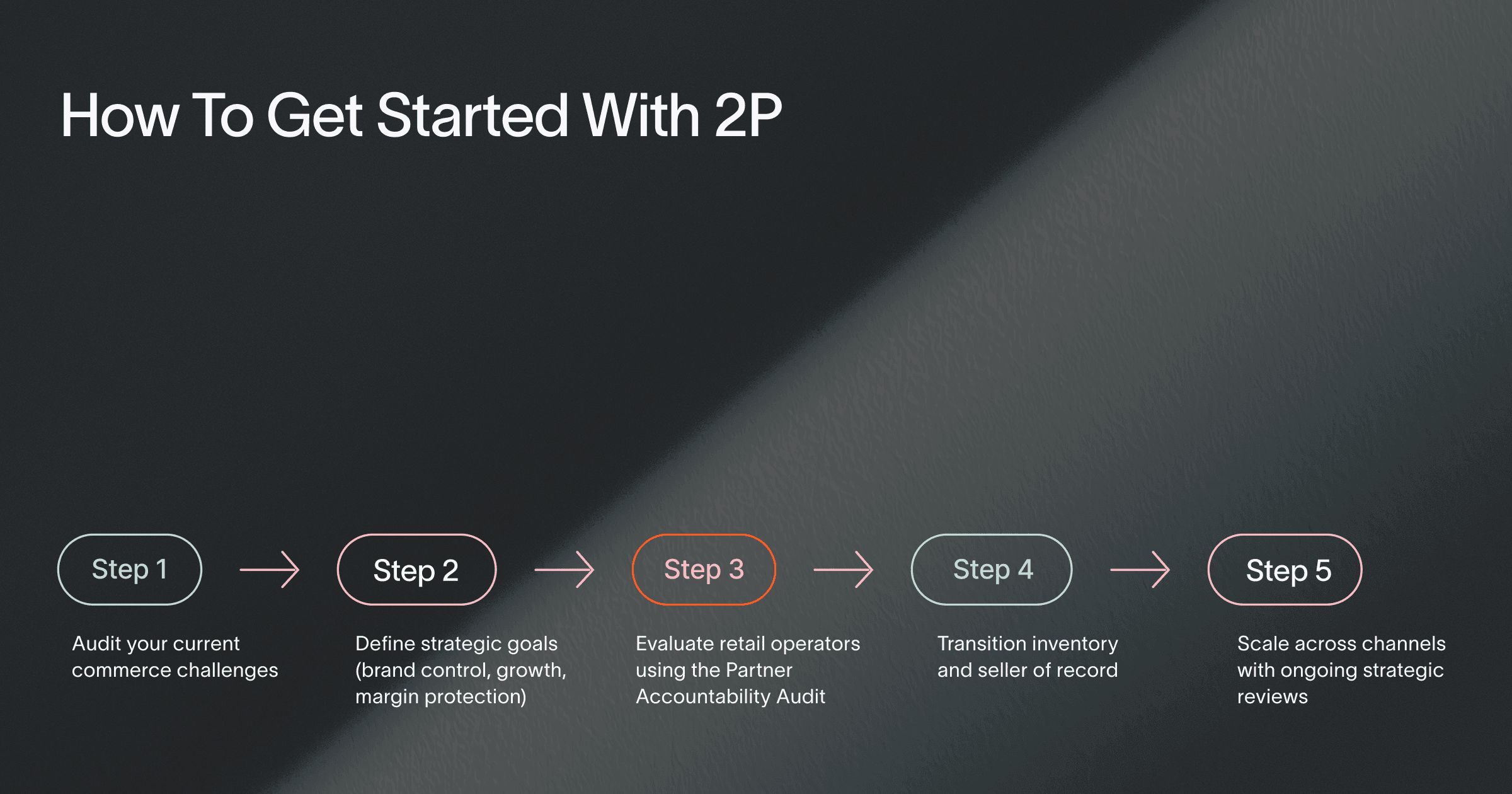
Switching to 2P Takes Less Than You Think
The typical onboarding runs in two phases: the first 30 days focus on transition: transferring the seller of record, reconciling existing inventory, auditing the catalog, and establishing the operating baseline. Days 31–90 are stabilization: cleaning up what the audit found, rebuilding the campaign structure, and getting account health metrics to where they should be. Growth accelerates from there.
Before you sign with any commerce partner, ask five structural questions from the Partner Accountability Audit:
Who owns inventory risk?
Who is the seller of record across all channels?
How is your fee structure aligned with our success?
What happens operationally when something breaks?
Can you operate every channel from one inventory pool?
A technically excellent agency can fail all five. The issue is never talent. It's always incentive structure.
Ready to See If 2P Fits Your Brand?
Let's talk about your ecommerce operation.
One PO. One partner. Every channel. Total accountability.
What Is the 2P Ecommerce Model?
The 2P model is a commerce structure in which a retail operator purchases your inventory, becomes the seller of record across every channel, and runs the full commercial system as its own business: pricing, content, advertising, fulfillment, brand protection, and customer experience.
Unlike an agency or managed service, a 2P retail operator's revenue comes from selling products profitably, not from fees, retainers, or ad spend percentages. The incentive alignment is total because the inventory risk is total.
The term "2P" sits between 1P (where Amazon buys your inventory and controls the channel) and 3P (where your brand is the seller of record and manages everything directly). In 2P, a retail operator purchases your inventory and becomes the seller of record, combining 1P's operational ownership with 3P's channel control and brand visibility.
For a deeper breakdown of the model, the four structural failures of the agency model, and the Partner Accountability Audit framework, read The 2P Playbook.


