
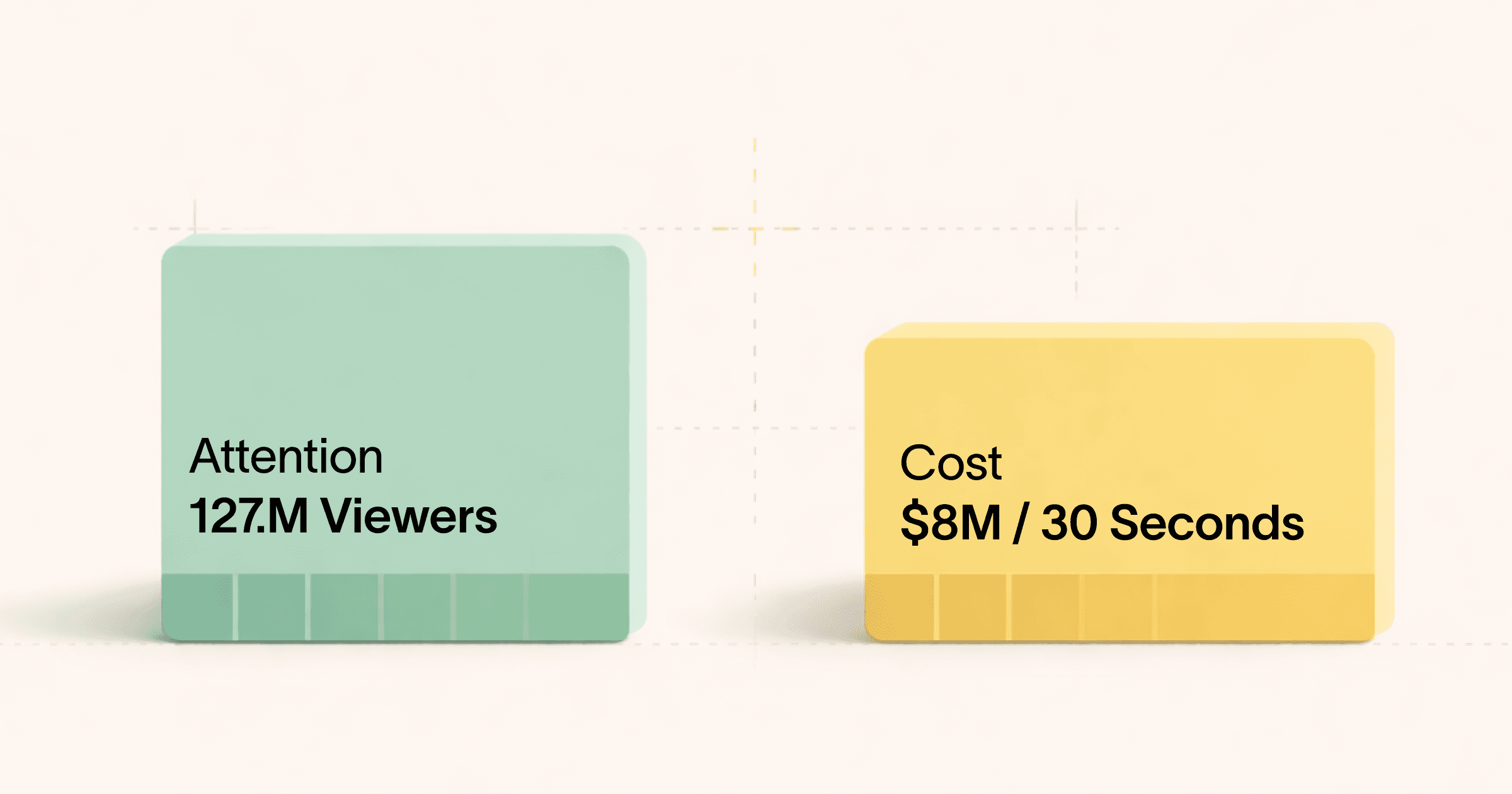
The Super Bowl is, by the data, the most underpriced mass-audience advertising event in American media, delivering a $42–63 CPM to 127.7 million attentive, non-skipping viewers, with documented Amazon sales lifts of 35–182% in the week following the broadcast. The $8 million sticker shock hides a conversion engine that outperforms every alternative…
Here's the full economic breakdown.
On February 9, 2025, somewhere in the Fox broadcast compound at Caesars Superdome in New Orleans, a clock ticked past zero on a thirty-second window of airtime. It was one of sixty-three such windows scattered throughout the evening, each one costing its buyer between seven and eight million dollars. By the time the Philadelphia Eagles hoisted the Lombardi Trophy that night, Fox had collected more than $800 million in advertising revenue from a single broadcast, more than the annual GDP of a dozen countries.
And the advertisers? They'd spent that money to reach a television audience of 127.7 million people, the largest in American broadcasting history. A number that, in an era when a hit primetime show draws eight million viewers and a viral TikTok might reach fifty million over a week, borders on the absurd.
This is the economics of Super Bowl advertising in 2026: a market where thirty seconds of airtime costs more than most Americans will earn in a lifetime, where the all-in cost of a single commercial can exceed $50 million, and where the fundamental question (is it actually worth it?) has never been more urgent or more answerable.
The answer, it turns out, depends entirely on what you mean by "worth it." And the math is more interesting than the sticker shock suggests.
The Real CPM Math
The Full Price of Admission
The number that dominates every pre-Super Bowl news cycle (this year, it’s $8 million for a 30-second spot on NBC) is, in the language of military strategists, a known known. What’s less understood is that it represents roughly half the actual cost of showing up.
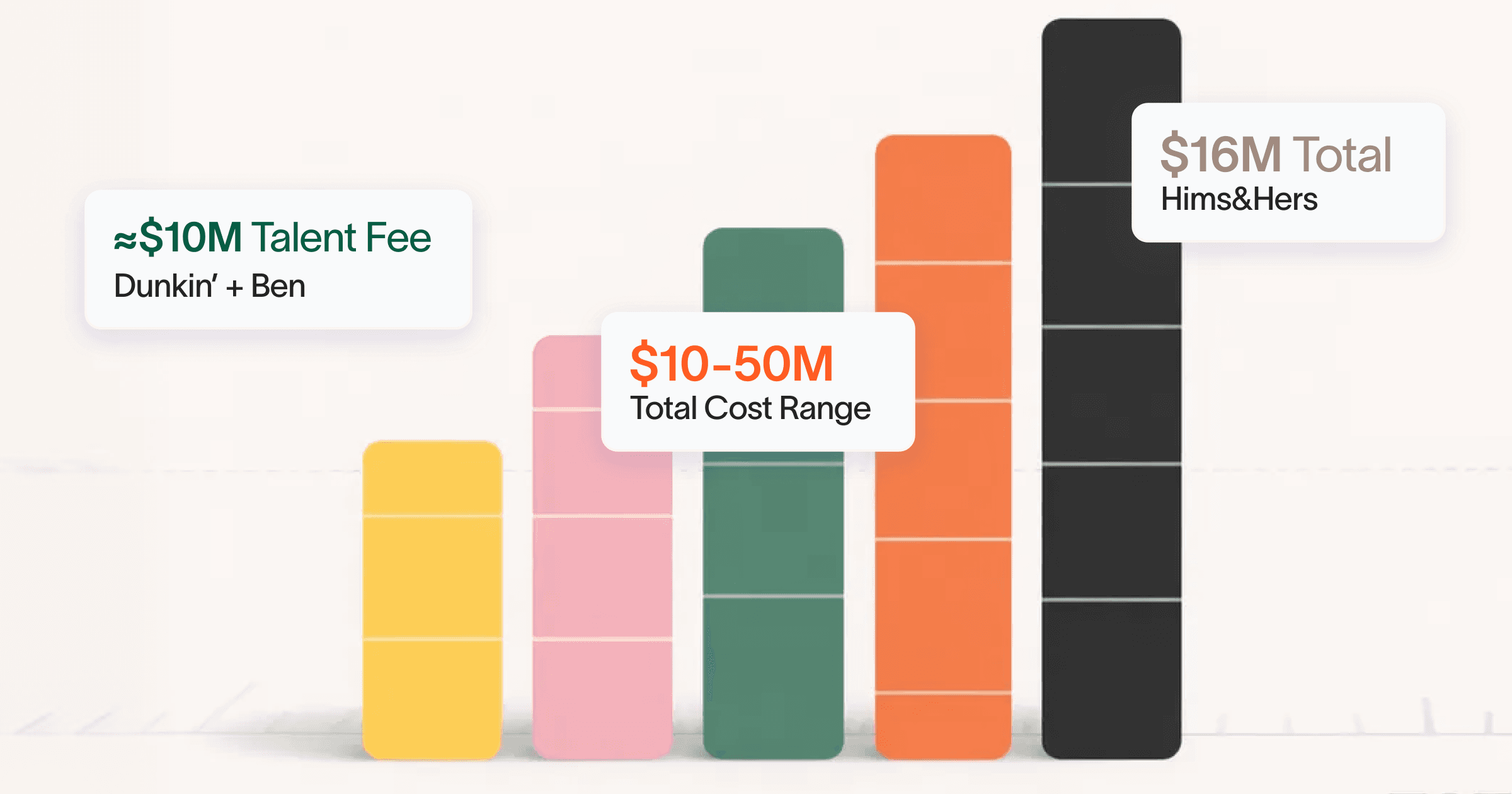
“The all-in cost for a Super Bowl commercial is $10 million to $12 million on the low end, and $20 million-plus on the high end,” the Hollywood Reporter reported in February 2025, and that was before NBC pushed the average rate card another million dollars north. CNN’s reporting from 2024 put the ceiling even higher: “Brands can spend between $15 million and $50 million for a single Super Bowl commercial, with $10 to $15 million spent on talent alone.”
The airtime buy is just the tip of the iceberg. Below the waterline lies a cost structure that would make a Hollywood studio blush:
Component | Typical Range | Notes |
|---|---|---|
Airtime (30 seconds) | $7–8M | The base media buy for 2025–2026 |
Production | $1–5M | Filming, VFX, editing, music licensing |
Celebrity talent | $1–10M+ | Varies wildly by star power |
Agency fees | $500K–2M | Creative development and strategy |
Social/digital amplification | $1–5M | Teasers, influencer seeding, paid social |
PR & earned media | $500K–2M | Press strategy, events, activations |
For the New York Times’ reporting on Super Bowl LI in 2017, companies spent between 25% and 100% of their airtime cost on additional marketing tied to the ad’s promotion. Applied to 2026 pricing, that means a brand buying an $8 million spot should budget $10 million to $16 million in total, at minimum.
Some brands spend far more. When Dunkin’ enlisted Ben Affleck for their 2023 Super Bowl campaign, the celebrity fee alone was approximately $10 million, according to CNN, citing three sources with knowledge of the deal. Affleck also helped conceive the creative and directed through his production company, Artists Equity. When Hims & Hers disclosed their 2026 Super Bowl investment to Inc. magazine, the number was $16 million for a single ad, nearly a year of production effort, produced in-house with a voiceover by Common.
At the extreme end, a brand running a 60-second spot with multiple A-list celebrities and a full multi-week campaign can clear $50 million. Forbes noted that 90-second Super Bowl commercials carry a price tag around $20 million in airtime alone.
And the price, like everything else in this economy, only goes in one direction. In 1967, the first Super Bowl charged $37,500 for thirty seconds. By 1995, it crossed $1 million. By 2017, $5 million. NBC’s Mike Marshall confirmed in January 2026 that “a handful” of this year’s spots sold for north of $10 million, the first time any Super Bowl ad has crossed that threshold. Sports Business Journal is already speculating about when the average rate card hits $10 million, and the smart money says 2028.
The trajectory is almost perfectly exponential: a 281% increase from 2000 to 2026, with the last six years alone accounting for a 43% climb. At $8 million for 30 seconds, the math works out to $266,666 per second of airtime. At premium placement rates, it’s $333,333.
Danny Winer, CEO of HexClad, the DTC cookware brand that made its Super Bowl debut in 2025 alongside Gordon Ramsay and Pete Davidson, put it with characteristic understatement: “To pay for this, I’ve got to start driving Ubers on the weekend, it’s so expensive.”
So why does anyone pay it?
The Last Campfire
To understand why brands keep writing these checks, and why the checks keep getting bigger, you have to understand what’s happened to every other mass-audience event in American media.
The Oscars drew 32.9 million viewers in 2017. By 2024, that number had dropped to 19.5 million, a 41% decline. The Grammys fell from 26 million to 15.4 million over the same period. The NBA Finals averages 12 to 18 million per game. The World Series, roughly the same. A hit broadcast sitcom is lucky to crack 8 million.
The Super Bowl, meanwhile, went the other direction. From its pandemic-era trough of 95.2 million in 2021, it climbed to 115.1 million in 2023, then 123.7 million in 2024, then an all-time record of 127.7 million in 2025. Three consecutive years of record-breaking viewership, accomplished during the peak of cord-cutting, when traditional pay-TV lost roughly a quarter of its subscriber base.
The 2025 broadcast captured a household share of 83%. That means of every American with a television turned on during the Super Bowl, more than eight out of ten were watching the game. The adults 25–54 rating of 42.8 set a new demographic record. Peak viewership during the second quarter hit 137.7 million. Total reach across all platforms (broadcast, streaming, Spanish-language simulcast) was 191.1 million unique viewers.
No other media event in the Western world produces numbers in the same area code.
“Where else can you get 100 million viewers at once?” asked Amy Leifer, DirecTV’s chief advertising sales officer, in a February 2025 CNBC interview. “Especially in this fragmented landscape… there’s virtually few places you can go to get that type of scale.”
She’s not wrong. The Super Bowl is the last campfire around which the entire culture gathers, not out of obligation, but out of genuine desire. And unlike virtually every other form of television, the audience doesn’t just tolerate the advertising. They come for it.
This is the statistic that separates the Super Bowl from every other media buy on earth: according to Statista, 43% of American viewers say they tune in specifically to watch the commercials. A Harris Poll survey from 2023 found that 75% of planned viewers said they were “excited for the ads.” YouGov data from 2024 pegged 14% of the audience (roughly 17 million people at Super Bowl scale) as watching primarily for the advertising.
Fourteen percent might sound small until you realize it represents more viewers than the Grammys attract in total.
The result is a media environment that is, quite literally, the inverse of normal television. Regular TV: DVR ad-skipping rates run 50–60% on recorded content. Streaming pre-roll: skip rates of 65–80% when available. The Super Bowl? Virtually zero. TVision, which maintains the industry’s largest passive in-home attention measurement panel, has documented that during the Super Bowl, ads actually score higher attention than the game itself, with an attention proportion of 114.0 for ads versus 112.1 for the game programming.
Read that again: people pay more attention to the commercials than to the football.
The Math Nobody Does (But Should)
The sticker shock of $8 million tends to short-circuit the analytical thinking of even sophisticated marketers. But the CPM calculation (cost per thousand impressions, the universal currency of media buying) tells a more nuanced story.
The arithmetic is straightforward:
Super Bowl LIX (2025):
Cost: $8,000,000 for 30 seconds
Average viewership: 127,700,000
CPM = ($8,000,000 ÷ 127,700,000) × 1,000 = $62.65
Calculated against total reach of 191.1 million unique viewers:
CPM = ($8,000,000 ÷ 191,100,000) × 1,000 = $41.86
Now compare that to every other major ad buy in the market:
Platform / Event | Average CPM | Audience Quality |
|---|---|---|
Super Bowl (2025) | $42–$63 | Live, attentive, culturally engaged, zero ad-skipping |
Academy Awards (2025) | $85–$128 | Declining, fragmented |
Olympic primetime (2024) | $22–$28 | Spread across two weeks |
Sunday Night Football (regular) | $35–$60 | Live but smaller (15–20M) |
Average primetime broadcast | $15–$35 | DVR-shifted, low attention |
CTV / Streaming | $20–$50 | Growing but skippable |
$8–$20 | Scroll-past, 1–2 seconds of attention | |
TikTok | $6–$25 | High engagement, small per-impression windows |
YouTube pre-roll | $10–$30 | Frequently skipped |
Programmatic display | $2–$6 | Bot fraud, viewability issues |
The Oscars, it turns out, actually have a higher CPM than the Super Bowl ($85 to $128 versus $42 to $63) while delivering one-sixth the total audience. As S&P Global reported in February 2025, the Super Bowl’s CPM has exceeded $55 for five consecutive years.
“But wait,” the performance marketer objects, “I can buy Instagram impressions for $9 CPM.” True. But what are you buying?
EDO, the advertising analytics firm, quantified this gap: they estimate that one Super Bowl ad is equivalent to approximately 450 primetime TV spots in terms of viewer engagement. Kevin Krim, EDO’s CEO, told CNBC: “It’s a fair and rational price based on our data, which is that this has been one of the most consistent performers over time. And there’s room for the price to go up based on our data.”
At $20–$35 CPM for primetime, 450 spots reaching a comparable total audience would cost far more than $8 million, and they’d be spread across weeks, diluting the cultural impact to near-zero.
Digiday ran the numbers on what $7 million could buy on alternative platforms in 2024: 140–200 million streaming impressions, 2.8–3.9 million TikTok clicks, or 4.4 million Walmart Connect clicks. Impressive volume. But none of those buys would land your brand in the cultural conversation for a month, generate billions of social impressions, or produce an asset that continues generating returns for years.
Which brings us to the evidence.
What the Data Actually Shows
The case for Super Bowl advertising rests on an increasingly robust body of evidence, from academic research to platform analytics, that consistently points in the same direction.
The Kantar Verdict
Kantar, the world’s largest data, insights, and consulting company, maintains the most comprehensive longitudinal dataset on Super Bowl advertising effectiveness. Their finding: a single Super Bowl ad is more than 20 times as effective as a typical TV ad at driving brand perceptions. The average ROI of Super Bowl ads reached $5.20 for every dollar spent in 2024, nearly doubling from $2.70 in 2020. Strong Super Bowl ads (those in the top creative effectiveness tier) deliver three times the ROI and 40% higher ad recall than average Super Bowl ads.
The even more striking figure, reported by Business Insider in January 2026: Kantar found that Super Bowl ads delivered an average ROI of $8.60 for every $1 spent, making them 20 times more effective than regular TV ads.
The Stanford Study
Wesley Hartmann of Stanford’s Graduate School of Business and Daniel Klapper of Humboldt University ran perhaps the most rigorous academic analysis of Super Bowl advertising effectiveness. Their finding: Budweiser earns an extra $96 million in revenue from its Super Bowl ads, a return on advertising investment of 172%. Budweiser’s sales revenue in the short run after the Super Bowl is 15.75% higher per household than for competitors.
The iSpot/EDO Metrics
iSpot‘s analysis of Super Bowl 2024 found that top-performing ads achieved 83.5% brand recall, a staggering 20 percentage points above the norm. EDO’s data showed the Super Bowl is three times as effective as average primetime programming for advertisers, with Super Bowl LIX specifically coming in at 224% more effective than primetime baselines.
The brand recall numbers are particularly striking when compared to regular television. Industry-wide, unaided recall for standard TV advertising hovers around 25–30%. For the Super Bowl, Ipsos research found that 87% of viewers could remember at least one advertiser unaided, with the average viewer recalling 3.5 brands without prompting.
Sales Lift: The Dollar Signs
The sales data tells the most compelling story:
Budweiser: 172% ROI, $96 million in incremental revenue (Stanford GSB)
Apple, 1984: $155 million in Macintosh sales in the three months following the “1984” ad, from a single airing, and the ad generated millions of dollars in free publicity as news programs rebroadcast it that night.
Old Spice, 2010: The “Man Your Man Could Smell Like” campaign, launched during Super Bowl weekend, drove a 125% increase in body wash sales within six months. The initial commercial garnered 10 million YouTube views within two months. Follow-up real-time response videos added another 80 million views. A brand that was functionally dead (“your grandfather’s deodorant”) was resurrected into cultural relevance for an entirely new generation.
Doritos, 2022: Following their Super Bowl ad, Spicy Nacho Doritos saw a 19% increase in add-to-list behavior, Spicy Sweet Chili an 11% lift, and Original Doritos a 6% bump.
And the evidence extends beyond the two weeks after the broadcast. The most successful Super Bowl ads become cultural artifacts that generate returns for years or decades. Budweiser’s Clydesdales have appeared in Super Bowl ads since 1986, a 40-year brand association that Stanford researchers estimate drives $96 million in annual incremental revenue. Volkswagen’s “The Force,” released in 2011, had 8 million views before it ever aired on television and was named by TIME as “the ad that changed Super Bowl commercials forever.”
Nielsen has described this dynamic as providing brands with “an almost endless annuity of earned media”: the Super Bowl ad becomes a permanent cultural artifact.
The Amplification Engine
The raw viewership is only the starting point. Super Bowl LIX generated 2.83 billion social media engagements across Instagram, X, and YouTube, a number that makes the 127.7 million live viewers look almost modest. Total social reach: 9 billion. TikTok halftime content alone accumulated 2.8 billion views.
The CeraVe campaign for Super Bowl 2024, created by Ogilvy, offers perhaps the most instructive case study of the modern amplification engine. Weeks before the game, the brand seeded fake paparazzi photos, influencer unboxings, and podcast appearances building the narrative: “What does Michael Cera have to do with CeraVe?” The pre-game earned media result: 9 billion impressions and $15.4 billion in earned media value before the ad ever aired. The Chicago Booth Review called it the future of Super Bowl advertising: “marketing to the algorithms.”
Jed Meyer of Kantar put the dynamics plainly: “While having a spot in the Super Bowl now costs about $7 million per 30 seconds, the real media value in Big Game advertising comes from how the spot is amplified across a variety of channels.”
The Launch Pad
If the Super Bowl is the world’s most expensive billboard, it’s also the world’s most effective launch platform: the place where unknown brands become household names and category disruptors rewrite the rules overnight.
Coinbase: The QR Code That Broke the Internet
In February 2022, Coinbase paid $13 million for a 60-second Super Bowl spot and aired what appeared to be a screensaver: a colorful QR code bouncing around a black screen for 60 seconds. Zero celebrities. Zero voiceover. Zero branding until the final frame.
The results: app installs jumped 309% week-over-week. The app and website crashed from the traffic surge. It became the most talked-about ad of Super Bowl LVI, proof that in an environment where every other brand is competing with celebrity spectacle, radical simplicity can be the ultimate disruption.
Tubi: Fifteen Seconds of Genius
Tubi, the free ad-supported streaming service, had a problem in 2023: almost nobody knew it existed. Their solution was a 15-second spot designed to look like someone accidentally switched the channel. Viewers across America accused family members of sitting on the remote.
The ad won the 2024 Grand Effie Award (the advertising industry’s highest effectiveness honor), plus Gold at Cannes Lions for “Challenger Brand.” It cost a fraction of a 30-second spot. It outperformed campaigns that cost ten times as much.
Liquid Death: From Cult to Mass Market
When canned water brand Liquid Death made its first national Super Bowl ad buy in 2025, it was a test of whether a brand built on punk-rock irreverence could translate niche energy to a mass audience. EDO’s engagement data answered definitively: the ad was 704% more effective than the average Super Bowl LIX ad, making it one of the three most engaging ads of the entire broadcast.
Liquid Death returned for Super Bowl LX in 2026, proof that the ROI justified repeat investment. The lesson: brands with genuine cultural identity don’t need to sand off their edges for the Super Bowl. The edges are the differentiator.
Poppi: The DTC Graduation
Poppi, the prebiotic soda startup, used its first Super Bowl ad in 2024 as a declaration: we are no longer a DTC curiosity. We are a mass-market challenger to Big Soda. The results bore it out: Amazon sales increased 35% in the week following the broadcast. By 2026, under PepsiCo ownership, Poppi returned for its third Super Bowl.
The playbook is clear: for brands ready to make the leap from niche to mainstream, the Super Bowl compresses what would normally be a multi-year awareness-building process into a single evening.
The Before/During/After Playbook
The brands that extract the most value from the Super Bowl don’t treat it as a single-day event. They run a three-phase operation:
Before (2–4 weeks): Release teasers. Seed influencers. Build anticipation. Campaigns that released videos before game day generated 9.1 million YouTube views on average versus only 1.3 million for those that waited. Volkswagen’s “The Force” pioneered this approach in 2011: released four days early, it had 8 million views before kickoff.
During: Staff social media war rooms for real-time engagement. The gold standard remains Oreo’s “Dunk in the Dark” tweet during the 2013 Superdome power outage. Activate retail media. Run promotional pricing to convert awareness into immediate purchase.
After (2–6 weeks): Sustain the creative messaging. Retarget viewers who searched for the brand. Marketing Dive recommends first-time advertisers plan for at least six weeks of supporting content after the game. Without sustained follow-through, the Super Bowl effect decays within two to four weeks.
The Amazon Conversion Loop
The Conversion Funnel Nobody Talks About
Here is where the economics of Super Bowl advertising become most interesting, and most relevant, for consumer brands: the direct, measurable, immediate impact on ecommerce sales. Specifically, on Amazon.
This is the section of the Super Bowl advertising story that gets the least attention and deserves the most, because it transforms the Super Bowl from a brand-awareness play into a conversion engine with trackable, attributable ROI.
The Amazon Sales Spike
Jungle Scout Cobalt, which tracks Amazon sales data, published the most comprehensive analysis of Super Bowl advertising’s impact on Amazon revenue following Super Bowl LVIII (2024). The numbers are unambiguous:
Brand | Amazon Sales Lift (Week Post-SB) | Top Product Lift |
|---|---|---|
e.l.f. Cosmetics | +182% | Jelly Pop Dew Primer: +222% |
Nerds | +46% | Gummy Clusters: +100% |
Hellmann’s | +45% | 4-pack mayo: +280% |
Poppi | +35% | Classic Cola: +35% |
Reese’s | +31% | Party Pack Miniatures: +15% |
Lindt | +29% | Assorted truffles bag: +70% |
Skechers | +27% | Men’s Afterburn: +37% |
Google (Pixel) | +22% | Pixel 6a: +26% |
CeraVe | +20% | Moisturizing Cream: +18% |
Dove | +14% | Body care products |
The e.l.f. Cosmetics number is worth pausing on: a 182% increase in Amazon sales from a single Super Bowl ad. Not a 182% increase in awareness. Not a 182% increase in sentiment. A 182% increase in revenue, on the platform where the transaction actually happens.
Momentum Commerce‘s analysis of Super Bowl LIX (2025) added another dimension: Nerds Gummy Cluster 8oz bags generated over $600,000 in Amazon sales in the two weeks following the Super Bowl, more than double the entire product line’s Amazon sales in the two weeks prior.
The Search Spike
The mechanism is straightforward but powerful: a Super Bowl ad triggers a massive branded search spike on Amazon. The typical increase is 400–800% in branded search queries. That search traffic flows directly into Amazon’s conversion funnel: product detail pages, sponsored brand ads, and buy boxes.
The brands that capture this traffic are the ones that have prepared their digital shelf in advance. The brands that don’t are leaving money on the table.
The Activation Playbook
Momentum Commerce’s research identified a clear pattern separating the brands that maximize their Super Bowl investment from those that don’t:
The winners do this:
Update the digital shelf. New creative assets on Amazon storefronts, sponsored brand ads, and product detail pages, all aligned to the Super Bowl campaign. Duracell featured Tom Brady (the star of their TV spot) in both their Amazon sponsored brand placements and their brand store.
Dramatically increase paid share of voice. Duracell increased its paid share of voice on Amazon by more than 6 percentage points during Super Bowl weekend, while no competitor moved even a single point. Nerds nearly doubled their paid share of voice in the gummy candy category, from 8.54% to 16.05%.
Time promotional pricing. Sodastream ran a promotional discount on Amazon during the 2020 Super Bowl broadcast to convert viewers into buyers in real time. The conversion loop (see ad on TV, search Amazon, find deal, purchase) can complete in under two minutes.
Start early. Consumer engagement with Super Bowl advertising begins before game day. The Amazon support strategy should reflect the extended timeline.
Sustain the spend. The biggest sales lift occurs in the 7–10 days after the game. Brands that pull back their Amazon advertising spend on Monday morning are cutting off the conversion funnel at the moment of maximum intent.
This is exactly the kind of integrated commerce execution that separates a retail operator from a fragmented vendor stack. When one partner owns the advertising, the digital shelf, the inventory position, and the pricing strategy, the Super Bowl-to-Amazon conversion loop runs as a single system, not a relay race between four different vendors who don’t share data.
The Retail Media Convergence
The most sophisticated Super Bowl advertisers now think of their media plan as a single system: the TV spot creates awareness and intent; retail media (Amazon Ads, Walmart Connect, Instacart Ads) captures that intent at the point of purchase; and the digital shelf converts it into revenue.
“If someone tries your product for the first time during a Super Bowl promotion, RMNs allow you to keep that conversation going,” said Lori Johnshoy, head of global retail media network and CPG strategy at LiveRamp.
The convergence of broadcast television and retail media is the most significant structural shift in Super Bowl advertising economics in a decade. It means that for CPG brands (which already account for roughly a third of all Super Bowl ads) the investment is no longer a pure brand play. It’s a full-funnel conversion event, with measurable revenue on the other end. The brands that treat it as such outperform those that don’t by orders of magnitude.
The Case Against Super Bowl Ads
The Case Against (And What It Gets Wrong)
Skeptics of Super Bowl advertising make several arguments, and they deserve a fair hearing.
"The CPM is too high." At $58–63, Super Bowl CPM is roughly double average primetime. But CPM is a measure of cost per impression, and not all impressions are created equal. A Super Bowl impression (30 seconds of undivided attention from a viewer who chose to watch, who won't skip, and who will discuss it later) is not the same unit as a programmatic display impression that may involve a bot, a below-the-fold placement, or a user scrolling past at speed. EDO's equivalency data (one Super Bowl ad equals ~450 primetime spots in engagement) suggests the attention-adjusted CPM is actually lower than alternatives.
"You can reach more people on digital for the same money." You can reach more impressions. Whether you reach more people, meaningfully, is another question. Digiday calculated that $7 million in programmatic could buy 140–200 million streaming impressions. But those impressions are scattered across weeks, fragmented across platforms, and delivered without any of the cultural amplification that makes a Super Bowl ad compound over time.
"Most Super Bowl ads don't work." This is actually partly true, and it's the most important caveat. Kantar's data shows that strong Super Bowl ads deliver 3x the ROI and 40% higher recall than average Super Bowl ads, and that creative quality can multiply ROI by a factor of 12. The difference between a great Super Bowl ad and a mediocre one is not incremental; it's existential.
"Not every brand should buy a Super Bowl ad," said Nicole Penn, CEO of EGC Group, speaking to Marketing Dive. She's right. For a pure performance marketer with no brand-building ambitions, the Super Bowl is the wrong vehicle. But for a brand looking to shift its trajectory (to move from niche to mainstream, from challenger to contender, from known to unavoidable) the data says the Super Bowl works.
And the data is getting more precise every year. The combination of iSpot attention tracking, EDO engagement analytics, Jungle Scout Amazon sales monitoring, and real-time social measurement means that Super Bowl advertising effectiveness is no longer a matter of faith. It's a matter of math.
The Verdict
The economics of Super Bowl advertising in 2026 come down to a paradox: the most expensive advertising in the world is, for the right brand at the right moment, actually underpriced.
Not underpriced in absolute terms. Eight million dollars for 30 seconds is, by any measure, an enormous sum. But underpriced relative to what it delivers: simultaneous access to 130 million attentive viewers in the last remaining mass-audience moment in American culture; an attention quality metric that exceeds every other platform on earth; a cultural amplification engine that turns a 30-second spot into billions of social impressions; an ecommerce conversion funnel that drives immediate, trackable sales on Amazon and every major retail platform; and a long-tail asset that can generate returns for years or decades.
The key word is "for the right brand." The Super Bowl is not a universal solution. It's a force multiplier, and a force multiplier applied to nothing produces nothing. The brands that extract extraordinary returns are the ones that arrive with a genuine story to tell, creative that earns the audience's attention, a digital shelf optimized to convert the awareness spike into sales, and a sustain plan that extends the investment beyond the broadcast.
For those brands: the ones ready to scale, ready to be seen, ready to convert a cultural moment into a commercial inflection point, the Super Bowl isn't an expense. It's a catalyst.
The Super Bowl endures, and its advertising premiums keep climbing, because it offers something no algorithm can replicate: 130 million people, watching the same thing, at the same time, paying attention. In the attention economy, that's not just valuable. It's priceless.
Is Super Bowl Advertising Worth It for CPG Brands?
For CPG brands with strong product-market fit, a prepared Amazon digital shelf, and the creative ambition to earn the audience's attention, yes. The data is unambiguous: Kantar documents $8.60 ROI per dollar spent. Stanford researchers measured 172% ROAS for Budweiser. Jungle Scout tracked 35–182% Amazon sales lifts in the week following the broadcast.
The Super Bowl is no longer a pure brand-awareness play. It's a full-funnel conversion event: the TV spot creates mass awareness, the search spike flows directly into Amazon and retail media, and a prepared digital shelf converts that intent into revenue. The brands that treat the Super Bowl as an integrated commerce moment (not just a media buy) are the ones extracting outsized returns.
The brands that waste their investment are the ones that show up with derivative creative, an unprepared digital shelf, and no sustain plan after the broadcast. The Super Bowl is a force multiplier. What it multiplies depends entirely on what you bring to it.


