

Amazon gave CPG brands two options for a decade. Both are broken.
1P (Vendor Central): Amazon buys your product and resells it. Simple — until Amazon cuts your margins, changes your pricing, or terminates your account with a form letter.
3P (Seller Central): You sell directly on Amazon’s marketplace. More control — but now you’re running a retail operation. Warehousing. Advertising. Customer service. Buy Box management. All of it, on top of building the brand you already have a full-time job running.
CPG leaders keep asking: Isn’t there something in between?
There is. It’s called the 2P model — and it’s quietly becoming the preferred Amazon operating model for mid-market and enterprise CPG brands.
What Is the 2P eCommerce Model?
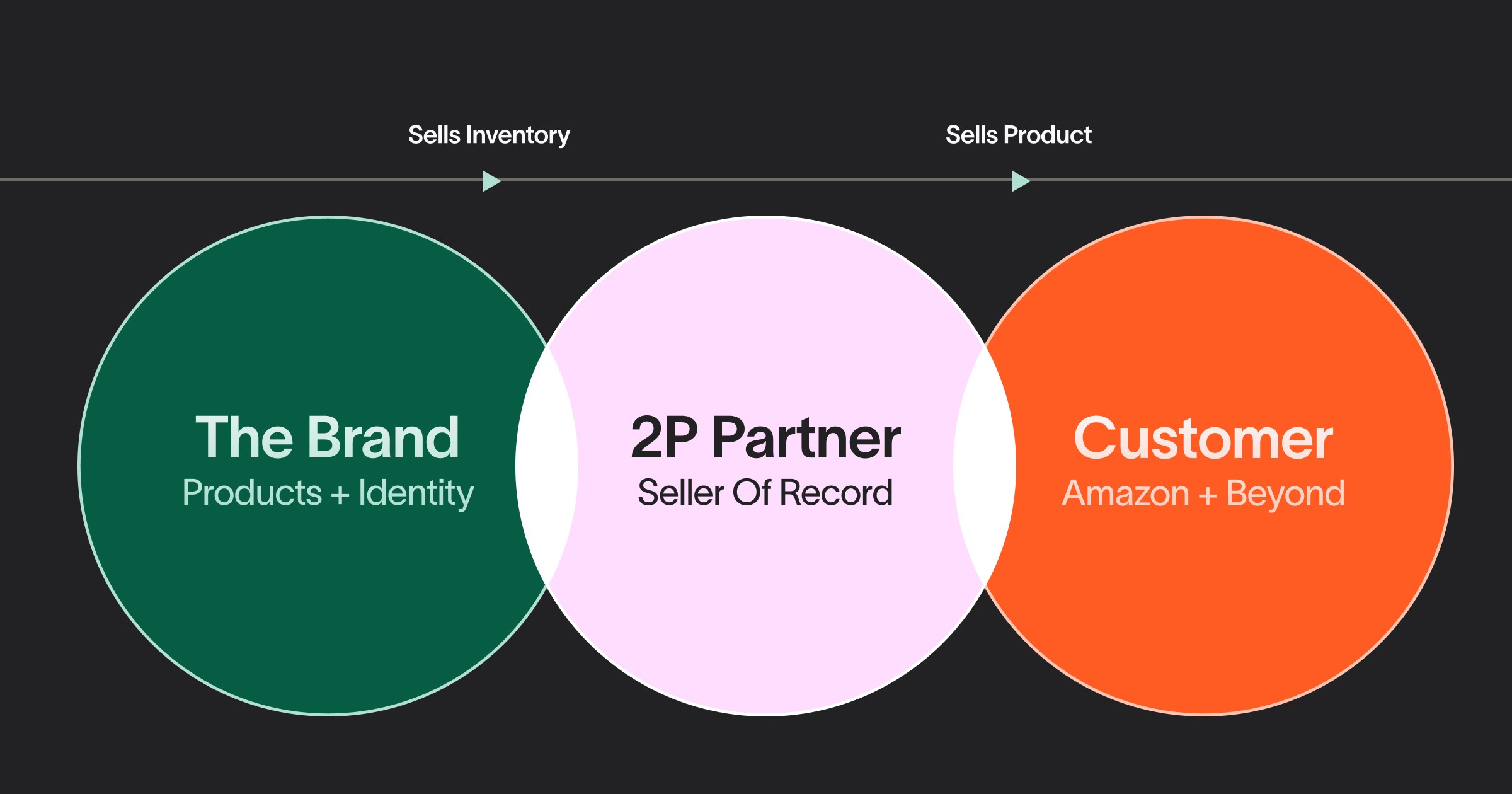
The 2P (second-party) eCommerce model is a retail partnership where a brand sells its inventory at wholesale to a specialized operator — the 2P partner — who becomes the seller of record on Amazon and other eCommerce channels. The 2P partner owns the inventory, manages all marketplace operations, and handles pricing, advertising, fulfillment, content, brand protection, and customer service. The brand retains full control over identity, product roadmap, and strategic positioning.
In plain English: you sell to them, they sell for you.
Unlike an agency (which advises and charges fees) or Amazon 1P (which buys your product but controls everything), a 2P partner operates your eCommerce business as a true retail operator with skin in the game — because they've purchased the inventory. Their economics are tied to selling your product profitably, not billing hours.
How the 2P Model Actually Works
Step 1: You Sell Inventory to the 2P Partner
The brand issues a purchase order to the 2P partner, just like selling to any retailer. The 2P partner pays on standard wholesale terms — net 30, net 60, whatever you negotiate. Predictable cash cycle.
Step 2: The 2P Partner Distributes Inventory
The partner sends inventory into Amazon's fulfillment network (FBA), their own warehouse, or both. They manage the supply chain: receiving, prepping, labeling, case-packing, and inbound logistics.
Step 3: The 2P Partner Becomes Seller of Record
On Amazon — and potentially on TikTok Shop, Walmart, and your Shopify store — the 2P partner is the listed seller. They own the Buy Box. They manage pricing. They run advertising. They create and optimize A+ Content. They handle customer inquiries and returns.
Step 4: Amazon Fulfills Orders
When a customer clicks "Buy Now," Amazon picks, packs, and ships through FBA. The 2P partner handles everything else: catalog management, competitive monitoring, review strategy, brand protection, and reporting.
What the Brand Keeps Control Of
This surprises most CPG leaders. In the 2P model, the brand retains:
Brand identity and guidelines — No one touches your brand without approval
Product roadmap and innovation — You decide what gets launched
Wholesale terms — You set the price you sell at
Creative sign-off — Final say on imagery, copy, positioning
Strategic direction — Channel selection, expansion plans, market positioning
Full visibility — Weekly snapshots, monthly business reviews, quarterly strategic planning
You're not handing over your brand. You're handing over the operations.
2P vs. 1P vs. 3P: The Comparison That Matters
Dimension | 1P (Vendor Central) | 3P (Seller Central) | 2P (Seller of Record Partner) |
|---|---|---|---|
Who sells | Amazon | Your team | 2P partner |
Who owns inventory | Amazon | You | 2P partner |
Pricing control | Amazon decides | You decide | 2P partner (with brand input) |
Advertising | Limited (AMS) | You run it | 2P partner runs it |
Brand protection | Minimal | Your responsibility | 2P partner handles it |
Margin visibility | Opaque | Full | Full (shared reporting) |
Fulfillment | Amazon | You manage FBA/FBM | 2P partner manages FBA |
Revenue model | Wholesale (Amazon dictates) | Direct sales | Wholesale (brand-negotiated terms) |
Risk | Amazon can terminate anytime | You carry all operational risk | 2P partner carries operational risk |
Operational burden on brand | Low (but no control) | Very high | Very low |
The 2P model resolves the central tension of Amazon for CPG brands: you want the simplicity of 1P without giving up control, and the control of 3P without running a retail operation.
Who Is the 2P Model Built For?
The 2P model isn't for everyone — and that's a feature, not a bug.
Built for CPG brands that:
Generate $10M+ in annual Amazon revenue (or have a clear path to it)
Are being squeezed, deprioritized, or terminated by Amazon Vendor Central
Don't want to build an in-house Amazon team of 5–15 specialists
Need a partner who operates the business, not one who sends PowerPoint decks
Value brand integrity and won't tolerate unauthorized sellers eroding their marketplace
Want financial certainty — a wholesale purchase order, not a complex fee structure
NOT for brands that:
Want direct control of every SKU's daily pricing
Are looking for a low-cost agency to run ads
Have a fully staffed, high-performing in-house Amazon team
Operate in categories where 2P economics don't work (extremely low-margin commodities, highly perishable goods)
The sweet spot? Mid-market to enterprise CPG brands doing $30M–$300M+ in revenue, with Amazon representing a significant but under-managed channel. Brands where the CEO or VP of Sales is saying, "Amazon is too important to ignore and too complex to run ourselves."
Why CPG Brands Are Moving to 2P Right Now
1. The Amazon Vendor Central Purge
Starting in late 2024, Amazon began aggressively pruning its 1P vendor roster. Thousands of brands received termination notices — some with 60 days to transition, others with less. For brands that built their entire Amazon business on Vendor Central, this was existential.
The 2P model is the natural landing zone. Brands can maintain a professional, operated Amazon presence without building an internal team from scratch under duress.
[Source: Multiple industry reports from Marketplace Pulse, Jungle Scout, and Amazon seller forums documented the 2024–2025 Vendor Central purge]
2. The Amazon Aggregator Collapse
Over $15 billion was invested in Amazon aggregators between 2020–2022. Most of that value has been destroyed — Thrasio's bankruptcy being the most notable casualty. The aggregator model (buy brands, "optimize" them, scale) turned out to be built on leverage, not operations.
The 2P model is fundamentally different. A 2P partner doesn't buy your brand. They buy your inventory. They're operators, not financial engineers. When a 2P partner succeeds, the brand succeeds — because the brand is still the brand.
[Source: Marketplace Pulse, "The Rise and Fall of Amazon Aggregators," 2024]
3. The Complexity Problem
Running Amazon in 2026 requires expertise across advertising (Sponsored Products, Sponsored Brands, DSP, AMC), content (A+ Content, Brand Story, video), supply chain (FBA prep, inventory planning, case-packing), brand protection (unauthorized seller removal, MAP enforcement, Transparency program), and analytics (Business Reports, Brand Analytics, search query performance).
No single brand manager can do all of this. An agency can advise on pieces of it. A 2P partner operates all of it — because they've purchased the inventory and their margin depends on doing it right.
The Economics: No Fees, No Rev-Share, No Surprises
This is where 2P breaks away from every other option.
No management fees. You're not paying a monthly retainer.
No revenue share. Nobody's taking a percentage of your Amazon sales.
No fulfillment costs to the brand. The 2P partner handles FBA fees, prep costs, and logistics.
No advertising costs to the brand. The 2P partner funds and manages advertising spend.
Your economics are clean: sell inventory at wholesale, get paid on terms, done. Your margin is locked in at the wholesale price. The 2P partner's margin comes from the delta between wholesale and the selling price on Amazon, minus operating costs.
This alignment is why the model works. The 2P partner is incentivized to sell at premium prices, maintain high in-stock rates, protect the Buy Box, and invest in advertising that drives profitable growth — because their P&L depends on it.
What Results Look Like
Brands operating under Neato's 2P model have seen:
+137% YoY revenue growth in premium coffee, with 29-point Buy Box improvement and sustained premium pricing
+204% YoY growth in pet wellness, driven by education-led advertising and catalog segmentation
+168% YoY growth in confectionery, reaching #1 market share in their category on Amazon
98%+ Buy Box rates across portfolios, compared to the 50–70% many brands experience with unmanaged listings
99%+ in-stock rates, eliminating revenue leakage from stockouts
[Source: Neato case studies — illy Coffee, Earth Animal, Wiley Wallaby]
Is the 2P Model Right for Your Brand?
Five questions:
Is Amazon growing slower than it should? If your Amazon channel is underperforming relative to your retail distribution, the operating model is likely the bottleneck — not the products.
Are you spending more time managing Amazon than building your brand? If your VP of Sales is in the weeds on Buy Box issues instead of closing retail deals, you've got an allocation problem.
Has Amazon 1P become unpredictable? Chargebacks, margin compression, CRaP-outs, the looming threat of termination — the risk-reward has shifted.
Are unauthorized sellers eroding your brand? Buy Box rate below 90%? Pricing a mess? You need an operator, not an email to Amazon support.
Do you want financial simplicity? If you're tired of managing agency fees, FBA invoices, advertising budgets, and a half-dozen vendor contracts, the wholesale simplicity of 2P might be exactly what you need.
Two or more yeses? The 2P model deserves serious evaluation.
The Bottom Line
The 2P eCommerce model isn't a new version of 1P, and it isn't 3P with a middleman. It's a structurally different approach to marketplace commerce — one where a specialized operator buys your inventory, becomes the seller of record, and runs your Amazon business like it's their own.
The brand sells to the partner. The partner sells to the customer. The brand focuses on what it does best: building products people love.
That's 2P. You sell to us. We sell for you.
Evaluating whether the 2P model fits your brand? Talk to our team — we'll walk you through the economics, the transition, and what the first 90 days look like. No pitch deck. Just a conversation between operators.


